Most lifters skip core training because they think it requires long sessions and complicated equipment. The opposite is true: ten minutes of focused work hits the entire core more effectively than many hour-long sessions because the intensity stays high throughout. The best 10 minute ab workouts use exercises that train multiple ab functions simultaneously, which lets a brief session deliver complete core stimulus.
Below are ten effective core exercises that fit into a 10-minute session. Together they cover trunk flexion, rotation, anti-extension, and isometric stability, which is the full functional range of the core. Pick four to five exercises and run them as a circuit for two to three rounds inside ten minutes.
Dumbbell Lying Woodchop

The Dumbbell Lying Woodchop lies on the back with a dumbbell held in both hands, and chops it diagonally from over one shoulder to the opposite hip. The rotational motion under load hits the obliques and rectus abdominis simultaneously.
Standard ab work mostly trains trunk flexion. The lying woodchop adds rotational loading, which is exactly the function the obliques perform during athletic movement. It pairs well with crunch variations because it covers a function those exercises miss.
Hold a dumbbell in both hands above one shoulder while lying flat. Rotate and crunch diagonally to bring the dumbbell toward the opposite hip. Reverse under control. Switch sides on each set. Use moderate weight; this is rotation work, not max strength.
Boat Yoga Pose
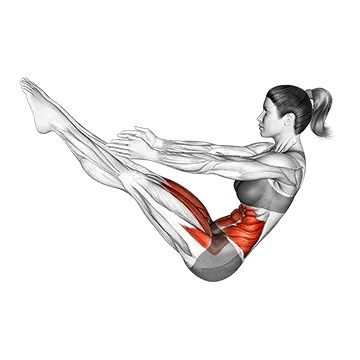
The Boat Yoga Pose sits on the floor with the legs extended and lifted off the ground, the torso leaned back, and the arms reaching forward. The position holds the entire core in a V-shape isometric contraction, which loads the rectus abdominis and hip flexors continuously.
For lifters who want core work that doubles as flexibility training, boat pose is excellent. The hip flexor and hamstring stretch while the abs are working under tension produces a different stimulus than dynamic ab work, and the isometric loading hits a fiber recruitment pattern that crunches alone miss.
Sit on the floor with knees bent. Lean back slightly while lifting the feet off the floor. Extend the legs forward and reach the arms toward the toes. Hold the position while breathing normally. Bend the knees if the position is too demanding initially.
Opposite Crunch

The Opposite Crunch lies on the back with one knee pulled to the chest and the opposite leg extended out, then crunches up to bring the opposite elbow toward the lifted knee. The diagonal motion engages the obliques alongside the rectus abdominis.
Where standard crunches hit primarily the rectus abdominis, the opposite crunch adds oblique work in one efficient movement. It is one of the most time-efficient ab exercises available because it trains two functions simultaneously rather than requiring separate exercises for each.
Lie flat with one knee pulled to the chest and the opposite leg extended above the floor. Crunch up and rotate to bring the opposite elbow toward the lifted knee. Lower under control. Switch sides on each rep or alternate by set.
Ab Tuck

The Ab Tuck sits on the floor with the legs extended and tucks the knees toward the chest while leaning back slightly. The combined motion of the legs and trunk loads the lower abs and hip flexors with each rep.
Ab tucks are a strong choice in any time-efficient ab routine because they hit the lower abs (which standard crunches mostly miss) and the upper abs simultaneously. The motion also requires good core stability throughout, which builds functional core strength alongside the visible ab muscles.
Sit with legs extended and hands on the floor for support. Tuck the knees toward the chest while crunching the trunk forward. Extend the legs back out without letting the heels touch the floor. Keep the rep continuous; the lower abs stay loaded through the entire set.
Bear Plank Kickback

The Bear Plank Kickback holds a bear plank position (hands and knees off the floor with knees hovering an inch above the ground) and kicks one leg back at a time. The kickback motion engages the glutes and hamstrings while the core fights to maintain plank position.
The bear plank itself is a brutal core exercise; adding the kickback intensifies it further by removing one limb of stability. The result is a movement that hits the core, glutes, and shoulders simultaneously, which makes it a high-value pick for time-efficient training.
Set up on hands and knees with the knees hovering an inch above the floor. Kick one leg back to full extension while keeping the hips level. Return under control and switch sides. The hips should not rotate or drop during the leg movement.
Seated Alternate Crunch

The Seated Alternate Crunch sits on the floor leaning back slightly with the legs extended and feet off the ground, then alternates crunching one knee toward the chest while extending the other. The continuous alternating motion loads the obliques and rectus abdominis simultaneously.
Where most ab exercises require lying flat, the seated alternate crunch uses a partial sit-up position that keeps the entire core engaged throughout. It also serves as a strong cardio piece when done at fast tempo because the heart rate rises quickly.
Sit with hands on the floor for balance, lean back to roughly 45 degrees, and lift the feet off the floor. Alternate bringing each knee toward the chest while extending the other leg straight out. Move at a steady tempo without rushing.
Jack Split Crunches

Jack Split Crunches lie on the back with arms overhead and legs together, then perform a crunch while simultaneously splitting the legs apart and bringing the arms down to the sides (jumping jack motion lying down). The combined upper and lower body movement makes the crunch significantly harder than the standard version.
Movements that combine multiple patterns into one rep tend to deliver more total stimulus per minute than isolated exercises. Jack split crunches hit the abs, hip flexors, and shoulders in one movement, which fits the time-efficient goal of a 10-minute ab session.
Lie flat with arms overhead and legs together. Crunch up while spreading the legs apart and bringing the arms down to the sides. Reverse under control. Maintain a continuous motion rather than pausing between reps.
Lying Ab Press

The Lying Ab Press lies on the back with knees bent at 90 degrees, hands placed on the thighs, and presses the hands into the thighs while the thighs press back against the hands. The opposing isometric contraction loads the abs without any movement at all.
Isometric core exercises are one of the most underrated tools in any ab program. The continuous tension without movement produces a different recruitment pattern than dynamic ab work, and the lying ab press specifically loads the deep core stabilizers that crunches alone miss.
Lie flat with knees bent at 90 degrees and feet flat on the floor (or knees in the air). Place the hands on the thighs. Press the hands into the thighs as hard as possible while the thighs press back. Hold for 10 to 20 seconds at a time, breathing normally throughout.
Bicycle Twisting Crunch

The Bicycle Twisting Crunch lies on the back with hands behind the head, alternates bringing opposite elbow and knee together while extending the other leg out. The continuous alternating motion targets the obliques and rectus abdominis under continuous tension.
The bicycle crunch is one of the most studied ab exercises in any program. Multiple research papers have ranked it among the highest-EMG ab exercises for both the rectus abdominis and the obliques, which means it produces strong muscle activation in both areas. For time-efficient training, few exercises beat it for total ab stimulus per minute.
Lie flat with hands behind the head and one knee tucked toward the chest. Bring the opposite elbow toward the tucked knee while extending the other leg out. Switch sides continuously, like riding a bicycle. Move at a controlled pace; speed is not the goal.
Lever Trunk Rotation

The Lever Trunk Rotation sits at a rotation machine and twists the trunk side to side against the machine’s resistance. The constant load hits the obliques through rotation, which is the function they actually perform during athletic movement.
Most ab programs are flexion-heavy and rotation-light, which leaves the obliques under-developed compared to the rectus abdominis. The lever trunk rotation directly addresses this gap with loaded rotation work. It is one of the few cable or machine exercises that earns regular inclusion in time-efficient ab routines.
Sit at the trunk rotation machine with the upper body braced against the pads. Rotate the trunk to one side against the resistance, pause briefly at full rotation, then return to center. Switch directions on each set. Move smoothly without jerking.
How To Program These Workouts
A productive 10-minute ab session runs as a circuit. Pick four exercises that hit different patterns: one trunk flexion (opposite crunch or bicycle twisting crunch), one lower ab move (ab tuck or jack split crunch), one rotation (dumbbell lying woodchop or trunk rotation), and one isometric or stabilization (boat pose or bear plank kickback). Run each exercise for 45 seconds with 15 seconds rest, repeat the circuit twice. Total time: 8 minutes plus 2 minutes warm-up.
Train abs three to five times per week. The core recovers quickly compared to larger muscle groups, so frequent training drives faster development than infrequent high-volume sessions. The 10-minute format makes daily practice realistic; pair it with morning coffee or end-of-day cooldown for consistent practice.
For more ab-focused programming, see our best lower ab workouts and best standing ab workouts. For broader core work, browse our abs exercise collection.
Final Thoughts
The best 10 minute ab workouts deliver more than the time investment suggests. Focused, high-intensity work for ten minutes produces real core development when done consistently. The exercises here cover every functional pattern the core operates in, which is what produces visible abs combined with adequate nutrition and lower body fat.
Stay consistent. Daily 10-minute sessions beat occasional 60-minute sessions for both visible abs and functional core strength. The body adapts to consistent, frequent stimulus better than to occasional heavy doses, and the abs respond particularly well to high frequency.
Frequently Asked Questions
Are 10 minute ab workouts enough?
For developing visible abs and building core strength, yes, when done consistently. Ten minutes of focused work, three to five times per week, produces more cumulative stimulus than a single hour-long session per week. The exercises matter more than the time spent; ten minutes of high-intensity work beats sixty minutes of half-effort movement.
Will 10 minute ab workouts give me visible abs?
The training builds the muscles, but visibility depends on body composition. Six-pack abs require both well-developed ab muscles and a low enough body fat percentage to see them. The 10-minute training works for the muscle development; the visible result requires combining it with appropriate nutrition.
How often should I do 10 minute ab workouts?
Three to five times per week works for most lifters. The core recovers within 24 to 48 hours of moderate training, so frequent practice produces faster development than infrequent sessions. Daily practice is fine if the volume per session stays moderate (roughly 70 percent effort), but daily maximum-effort sessions burn out the core within a few weeks.
What time of day is best for ab workouts?
Whatever time you can do consistently. Some lifters prefer morning sessions before the day gets busy; others fit them in after main training as a finisher. The best time is whichever time produces the most consistent practice over weeks and months, not whatever some optimization protocol claims is best.
Do I need any equipment?
Most of the exercises above are pure bodyweight. The dumbbell lying woodchop benefits from a moderate dumbbell (10 to 25 pounds), and the lever trunk rotation requires a rotation machine if available. Without those two, the other eight exercises cover the full functional core range with no equipment whatsoever.