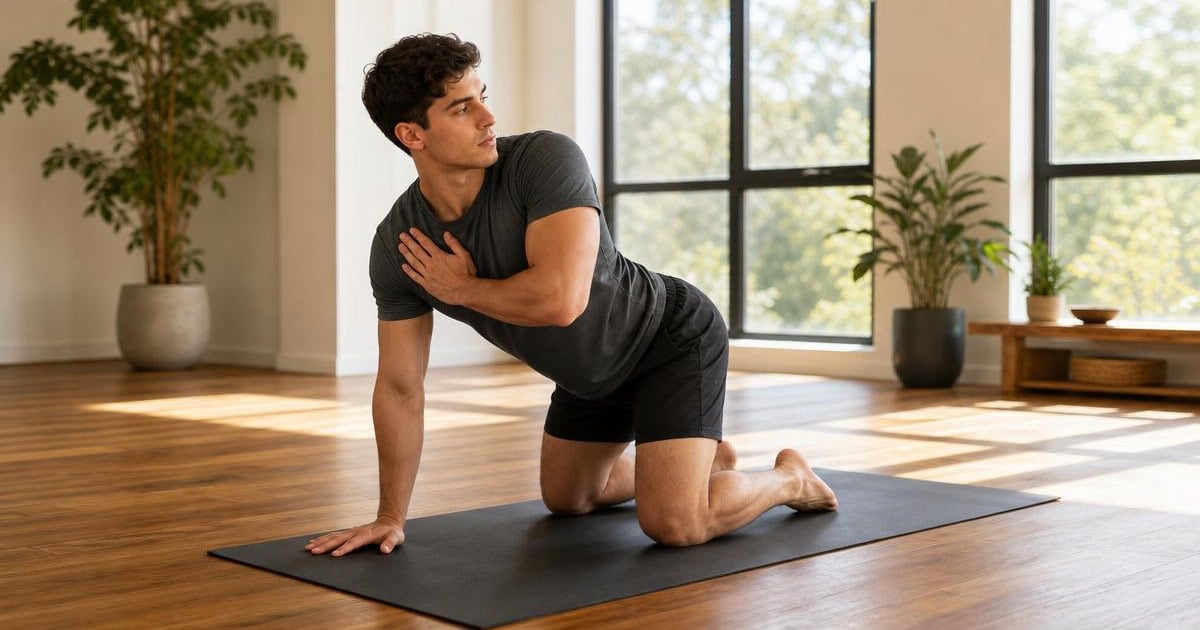
Improving thoracic mobility requires understanding the multiple movement components of the thoracic spine (the thoracic spine has rotation, flexion, extension, and lateral flexion – and modern lifestyle patterns like desk work and smartphone use restrict ALL of these motions, especially rotation and extension) and the training principles that develop comprehensive thoracic mobility: dedicated rotation training (thread the needle – the most direct rotation intervention), extension training (cobra pose, superman), flexion training (child pose, cat pose), dynamic mobility flowing between motions (cat-cow), upper back strengthening (Y raises, wall slides, band pull-aparts) for proper thoracic position support, and high-frequency consistent practice. Most people with restricted thoracic mobility have one or more of these issues: 8+ hours of daily desk work that restricts thoracic motion, smartphone use that pulls the thoracic spine into flexion, lack of dedicated thoracic mobility training, weak mid back muscles that fail to support proper thoracic position, and overall sedentary patterns that reinforce thoracic restrictions. Restricted thoracic mobility limits shoulder function (because shoulder mobility depends on thoracic mobility), contributes to lower back pain (because lumbar spine compensates for restricted thoracic motion), restricts athletic performance, and produces the rounded upper back posture common in modern lifestyle.
Below are ten of the most effective exercises for improving thoracic mobility, covering primary rotation training (thread the needle pose), thoracic flexion (child pose, cat pose), thoracic extension (cobra yoga pose, superman), dynamic mobility flow (cat-cow stretch), upper back strengthening (prone Y raise, forearm wall slide, dumbbell rear delt fly), and high-frequency mid back work (band pull apart). Together they form a complete thoracic mobility program. A 20 to 30-minute thoracic mobility session pulled from this list, performed 4 to 6 times per week (or as integrated work alongside your regular training), produces measurable thoracic mobility improvement within 4 to 8 weeks of consistent training – including better rotation, improved extension, integrated thoracic function that supports shoulder mobility, and the comprehensive spine function that supports athletic and daily activity.
Thread the Needle Pose
The Thread the Needle Pose performs thread-the-needle stretches. The pattern is THE most direct exercise for thoracic mobility.
For thoracic mobility, thread the needle is THE most direct intervention. The pattern produces deep thoracic spine rotation and stretching. Run it for 2 to 3 sets of 30 to 60-second holds per side, daily if possible.
Start on hands and knees. Slide one arm under the body and across to the opposite side, lowering the shoulder and head to the floor. The opposite arm can extend overhead or stay in place for support. Feel deep stretch through the upper back and shoulder of the threading arm. Hold for 30 to 60 seconds. Switch sides. The pattern is THE most direct exercise for thoracic mobility – thread the needle produces deep thoracic spine rotation that addresses the rotation restrictions common in modern lifestyle. Daily thread the needle (multiple sessions per day if possible) produces measurable thoracic mobility improvement within 2 to 4 weeks.
Child Pose

The Child Pose performs the yoga child pose. The pattern produces thoracic mobility through extended position.
For thoracic mobility, the child pose produces thoracic mobility through full upper-back stretching. Run it for 2 to 3 sets of 60 to 90-second holds as thoracic flexion mobility work.
Kneel on the floor with knees apart and big toes touching. Sit back on the heels. Extend the arms forward on the floor while lowering the torso between the thighs. Rest the forehead on the floor. Press the hands forward to stretch the shoulders and lats. Hold for 60 to 90 seconds. Breathe deeply. The pattern produces thoracic flexion mobility – the upper back rounds gently into stretched position, addressing thoracic flexion restrictions. Combined with extension patterns (cobra, superman), child pose provides balanced thoracic mobility through both flexion and extension.
Cobra Yoga Pose

The Cobra Yoga Pose performs the cobra back extension. The pattern produces direct thoracic extension.
For thoracic mobility, the cobra pose produces direct thoracic extension training. Run it for 2 to 3 sets of 30 to 60-second holds as thoracic extension mobility work.
Lie face-down on the floor with hands placed under the shoulders. Press through the hands while lifting the chest off the floor by extending the upper back. The thoracic spine extends as the chest opens up. Hold for 30 to 60 seconds. The pattern produces direct thoracic extension – thoracic extension mobility is critical for full shoulder mobility, proper posture, and athletic performance. Daily cobra pose (combined with thread the needle for rotation) produces comprehensive thoracic mobility through extension and rotation.
Cat Cow Stretch


The Cat Cow Stretch performs cat-cow flow. The pattern produces dynamic thoracic mobility through flexion and extension.
For thoracic mobility, cat-cow produces dynamic thoracic mobility flowing between flexion and extension. Run it for 2 to 3 sets of 10 to 12 reps as dynamic thoracic mobility work.
Start on hands and knees with hands under shoulders and knees under hips. Inhale and arch the back by lifting the chest, dropping the belly, and lifting the head (cow). Exhale and round the back by tucking the pelvis and pulling the navel toward the spine while dropping the head (cat). Continue alternating slowly with breath. The pattern produces dynamic thoracic mobility through both flexion (cat) and extension (cow) – excellent dynamic mobility work that combines thoracic flexion and extension training in single flowing movement.
Cat Pose

The Cat Pose performs the cat yoga pose. The pattern produces thoracic flexion mobility.
For thoracic mobility, the cat pose produces direct thoracic flexion mobility. Run it for 2 to 3 sets of 30 to 60-second holds as thoracic flexion work.
Start on hands and knees. Round the back by tucking the pelvis under, pulling the navel toward the spine, and dropping the head between the arms. Feel deep stretch through the entire spine. Hold for 30 to 60 seconds. The pattern produces direct thoracic flexion – addresses any thoracic extension restrictions while training the spine into flexion position. Combined with extension patterns (cobra, superman), cat pose provides balanced thoracic mobility.
Prone Y Raise

The Prone Y Raise performs prone Y raises. The pattern produces upper back strengthening supporting thoracic mobility.
For thoracic mobility, the prone Y raise produces upper back strengthening that supports proper thoracic position. Run it for 3 sets of 12 to 15 reps as upper back strengthening work.
Lie face-down on a bench or the floor with arms extended overhead in a Y position (about 45 degrees from the body). Lift the arms up by retracting the shoulder blades while maintaining the Y position. The lower traps and rear delts work hard. Squeeze at peak. Lower under control. The pattern produces direct lower trap loading – the lower traps support proper thoracic position and shoulder blade upward rotation, both of which support thoracic mobility. Strong lower traps complement thoracic mobility work.
Forearm Wall Slide
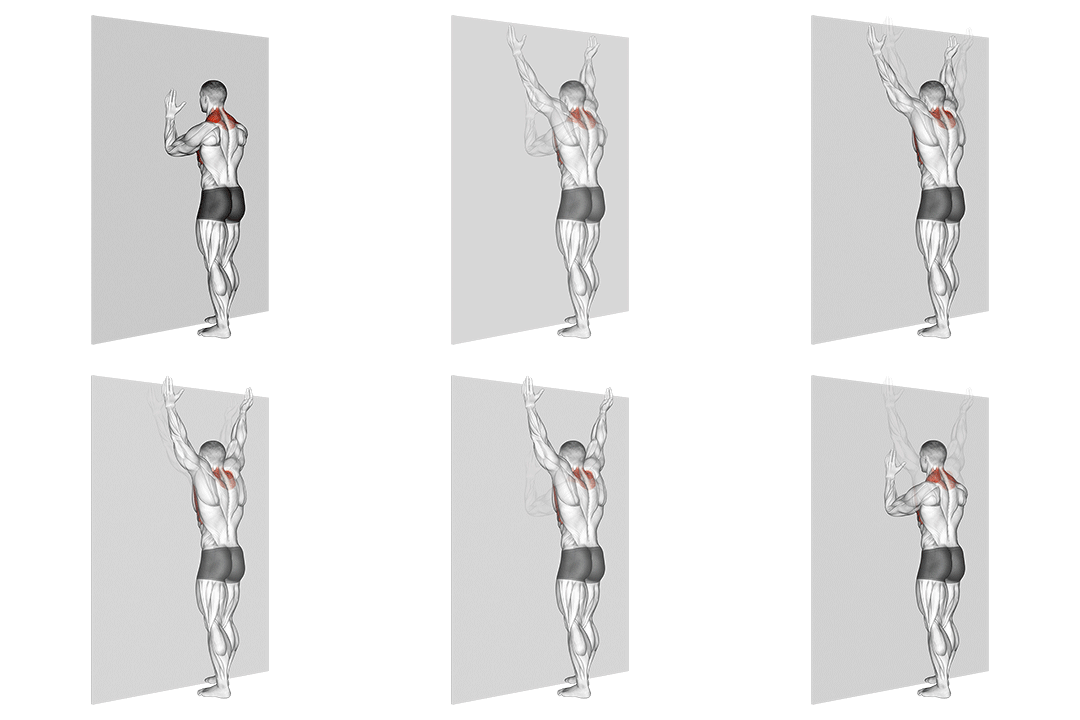
The Forearm Wall Slide performs wall slides with forearms. The pattern produces direct upper back and thoracic activation.
For thoracic mobility, the wall slide produces direct upper back activation while reinforcing proper thoracic position. Run it for 3 sets of 10 to 12 reps as posture activation work.
Stand with the back against a wall. Place the forearms and hands flat against the wall with elbows at shoulder height (about 90-degree angle). Slide the forearms up the wall while maintaining contact with the wall, the lower back, and shoulders. The lower traps, rhomboids, and rear delts work hard. Slide back down under control. The pattern produces direct upper back activation while teaching proper thoracic position against the wall – the wall serves as a reference for proper alignment. Excellent thoracic-specific exercise that reinforces both upper back strengthening and proper thoracic awareness.
Superman

The Superman performs prone superman holds. The pattern produces direct posterior chain extension work.
For thoracic mobility, the superman produces direct posterior chain extension that supports thoracic extension capacity. Run it for 3 sets of 10 to 15 reps or 30-second holds as extension strengthening work.
Lie face-down on the floor with arms extended overhead and legs straight. Lift both arms and legs off the floor simultaneously by extending the upper and lower back. The upper back, lower back, and glutes all work hard. Hold briefly at peak. Lower under control. The pattern produces direct extension strengthening – the thoracic extensors work hard to lift the chest off the floor, building the strength that supports thoracic extension mobility. Combined with extension stretching (cobra), superman strengthens the muscles that maintain extended thoracic position.
Band Pull Apart
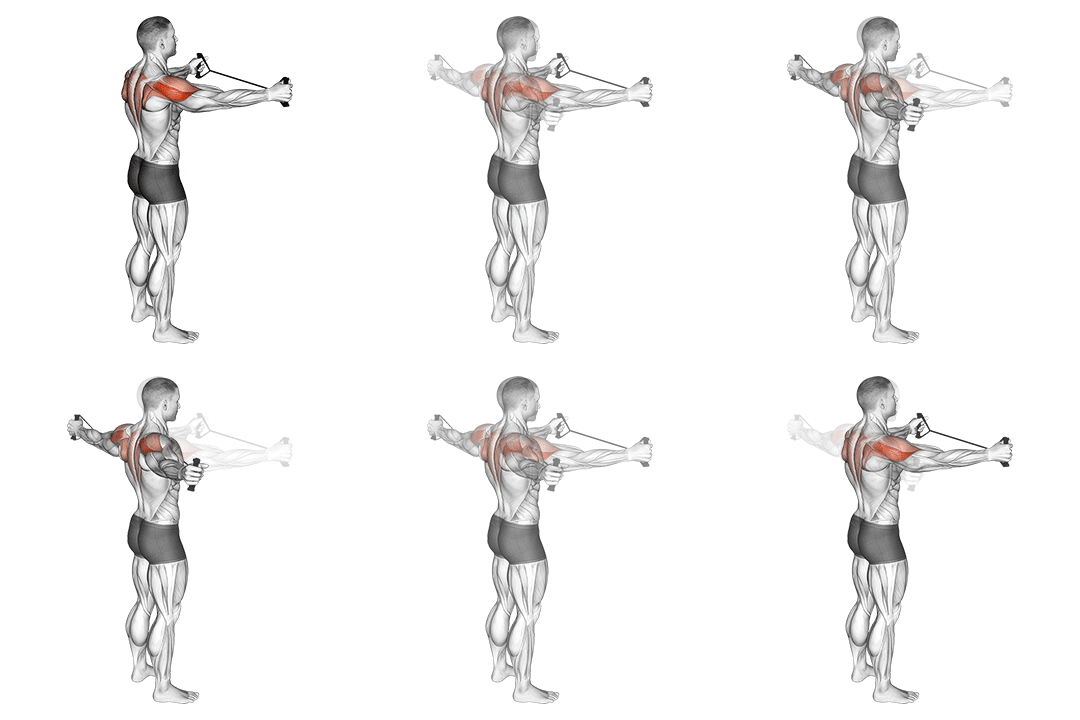
The Band Pull Apart performs pull-aparts. The pattern produces direct mid back loading supporting thoracic mobility.
For thoracic mobility, the band pull-apart produces mid back loading that supports proper thoracic position. Run it for 3 to 5 sets of 15 to 25 reps as daily mid back work.
Stand holding a resistance band with both hands at chest height with arms extended forward. The band should have moderate tension. Pull the band apart by retracting the shoulder blades and pulling the arms out to the sides until the band touches the chest. The rhomboids, rear delts, and mid traps work hard. Squeeze the shoulder blades hard at peak. Return under control. The pattern produces direct mid back loading – strong mid back muscles support proper thoracic position which is foundational for thoracic mobility. Daily band pull-aparts (50 to 100 daily reps) accelerate thoracic mobility improvement substantially.
Dumbbell Rear Delt Fly
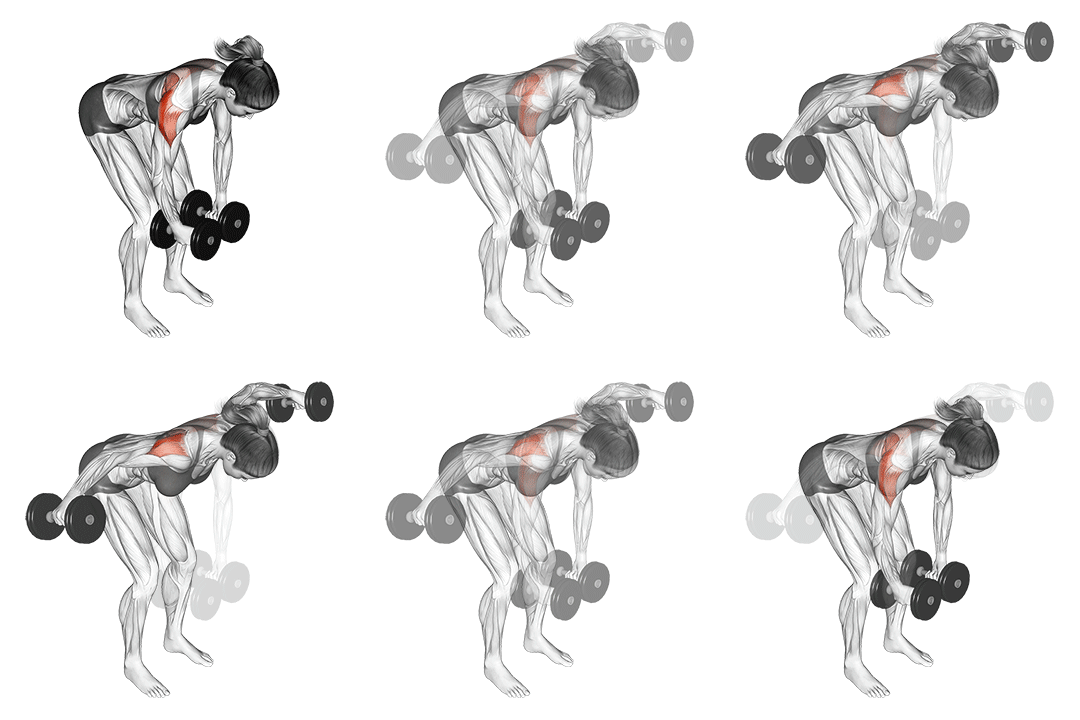
The Dumbbell Rear Delt Fly performs rear delt flies. The pattern produces direct rear delt isolation supporting thoracic position.
For thoracic mobility, the rear delt fly produces direct rear delt loading supporting proper shoulder and thoracic position. Run it for 3 to 4 sets of 12 to 15 reps as rear delt work.
Stand with feet hip-width holding dumbbells. Hinge forward at the hips with a flat back so the torso is parallel to the floor. Hold the dumbbells underneath the chest with palms facing each other. Lift the dumbbells out to the sides by raising the arms straight out to shoulder height. The rear delts and rhomboids work hard through horizontal abduction. Squeeze hard at peak. Lower under control. The pattern produces direct rear delt isolation – rear delts contribute to proper shoulder position which supports proper thoracic position. Combined with mid back work, rear delt training supports the muscular environment for thoracic mobility.
How To Program These Workouts
A productive thoracic mobility session pulls 6 to 8 exercises from the list above. A common balanced session: thread the needle pose (rotation – primary), cobra yoga pose (extension), child pose (flexion), cat-cow stretch (dynamic flow), prone Y raise (lower trap strengthening), forearm wall slide (posture), band pull apart (mid back), superman (extension strengthening). For high-frequency daily work: thread the needle pose (multiple times daily), cobra yoga pose (daily), cat-cow stretch (daily), band pull apart (daily). For dedicated mobility sessions: include all 10 exercises with appropriate volume. Run static mobility for 2 to 3 sets of 30 to 90-second holds, dynamic mobility for 2 to 3 sets of 10 to 12 reps, upper back strengthening for 3 to 4 sets of 10 to 15 reps, mid back work for 3 to 5 sets of 15 to 25 reps daily.
Train thoracic mobility 4 to 6 times per week for accelerated improvement. Most successful thoracic mobility programs incorporate work as: 1) daily thread the needle (multiple sessions per day if possible) – the single most important rotation intervention, 2) daily cat-cow and cobra (dynamic and extension mobility), 3) daily band work (band pull-aparts, Y raises) for upper back strengthening, 4) 2 to 3 weekly dedicated mobility sessions (6 to 8 exercises), 5) integrated thoracic work in main lifting sessions (warm-up). The thoracic spine tolerates very high frequency mobility work – daily multiple-session practice plus dedicated sessions accelerates improvement substantially. Most individuals see measurable thoracic mobility improvement within 4 to 8 weeks of consistent practice.
For broader programming, see our how to improve shoulder mobility and how to fix forward head posture. For specific work, see our how to fix rounded shoulders.
Final Thoughts
Improving thoracic mobility requires applying the right training principles consistently over time: daily rotation training (thread the needle – the most direct rotation intervention), extension training (cobra, superman), flexion training (child pose, cat pose), dynamic mobility flow (cat-cow), upper back strengthening for proper thoracic support, high-frequency mid back work for posture, and consistent practice with high frequency. The combination of thread the needle, child pose, cobra, cat-cow, cat pose, Y raises, wall slides, supermans, band pull-aparts, and rear delt flies covers every component of thoracic mobility and produces broader spine and shoulder function improvement than any single approach. Most individuals who consistently apply these principles see measurable thoracic mobility improvement within 4 to 8 weeks – including better rotation capacity, improved extension mobility, the integrated thoracic function that supports shoulder mobility, less lower back pain (because lumbar spine no longer compensates for thoracic restrictions), better posture, and improved athletic performance. For anyone with thoracic mobility restrictions from desk work or sedentary lifestyle, dedicated thoracic mobility training is one of the most effective interventions available.
Stay focused on consistent daily practice rather than occasional intense sessions. The most common mistake people make in thoracic mobility work is doing intense mobility sessions occasionally rather than consistent daily practice. The fix: prioritize daily thread the needle (multiple sessions per day if possible, especially after prolonged desk work), daily cat-cow flows, and daily band pull-aparts. The thoracic spine tolerates very high frequency mobility work – daily multiple-session practice accelerates improvement substantially compared to once-weekly intense sessions. Combined with upper back strengthening (Y raises, supermans) and adequate lifestyle adjustments (reduced sitting time when possible), daily mobility practice produces the thoracic improvements that occasional sessions never achieve.
Frequently Asked Questions
How long does it take to improve thoracic mobility?
4 to 8 weeks for measurable improvement, ongoing for full mobility. Most individuals who consistently apply daily thread the needle plus dedicated mobility sessions see measurable improvement within 4 to 8 weeks – better rotation capacity, improved extension, less upper back stiffness. Severe thoracic restrictions (from years of desk work and chronic poor posture) may require 3 to 6 months of consistent work for full improvement. Most people see initial improvement within 2 to 3 weeks of starting consistent daily practice.
What’s the best exercise for thoracic mobility?
Thread the needle pose – the most direct rotation intervention. Thread the needle produces deep thoracic spine rotation that addresses the rotation restrictions common in modern lifestyle. Combined with cobra (extension), cat-cow (dynamic flow), child pose (flexion), and upper back strengthening (Y raises, wall slides), these form the foundation of thoracic mobility improvement. Most successful programs prioritize daily thread the needle (multiple sessions if possible) as the cornerstone of thoracic mobility work.
Why is my thoracic spine so stiff?
Most commonly from desk work, smartphone use, and lack of mobility work. Modern lifestyle (8+ hours of daily sitting, smartphone use, computer work) keeps the thoracic spine in restricted positions for hours daily, producing chronic thoracic mobility restrictions. Other contributors: lack of dedicated thoracic mobility training, weak mid back muscles, restricted shoulder mobility (which often accompanies thoracic restrictions). The fix: high-frequency mobility work, balanced upper back training, dedicated mobility sessions, reduced sitting time when possible.
Can thoracic mobility be improved?
Yes – thoracic mobility responds well to dedicated training. Most thoracic mobility limitations stem from soft tissue restrictions and sedentary lifestyle patterns – both of which respond very well to dedicated training. Thoracic mobility caused by structural issues (severe scoliosis, advanced arthritis) may have limited correction potential and require professional evaluation. For typical limitations from modern lifestyle, dedicated training produces measurable improvement for almost everyone within 4 to 8 weeks of consistent practice.
How often should I do thoracic mobility work?
Daily thread the needle plus 2 to 3 dedicated sessions weekly. The thoracic spine tolerates very high frequency mobility work – daily mobility practice accelerates improvement substantially. Most successful thoracic mobility programs include: daily thread the needle (multiple sessions per day if possible), daily cat-cow and cobra, daily band work for upper back, 2 to 3 weekly dedicated mobility sessions with 6 to 8 exercises, integrated thoracic work in main lifting sessions. Combined approach produces measurable thoracic mobility improvement within 4 to 8 weeks for most individuals.