Barbell Reverse Grip Bench Press

Description
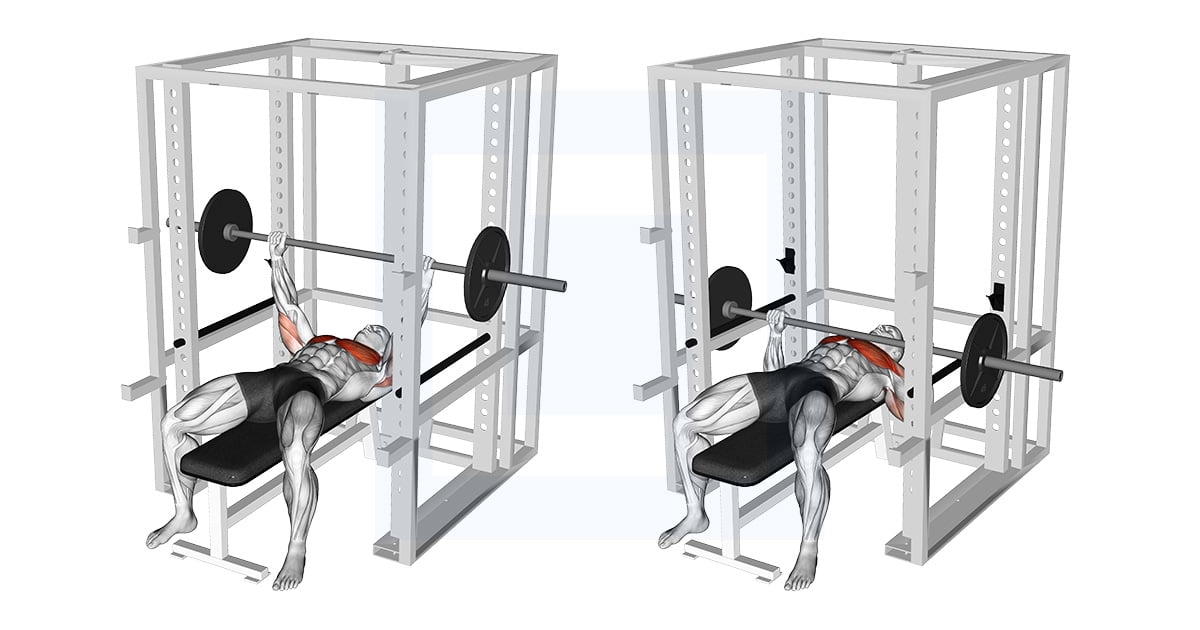
The barbell reverse grip bench press uses a supinated (underhand) grip on the bench press. The reverse grip shifts emphasis toward the upper (clavicular) chest and reduces front delt involvement. It requires a spotter for safety due to the less secure grip.
Equipment Required
Barbell Reverse Grip Bench Press Instructions
- Lie on a flat bench. Grip the barbell with a supinated (underhand) grip, hands shoulder-width apart.
- Have a spotter help you unrack — the reverse grip is less secure than overhand.
- Lower the bar to your lower chest or upper abdomen.
- Press up to lockout.
- The reverse grip naturally tucks the elbows, which is easier on the shoulders.
- Always use a spotter with this grip — bar security is reduced.
- Use lighter weight than standard bench press.
- Aim for 8 to 12 reps per set.
Barbell Reverse Grip Bench Press Form & Visual

Barbell Reverse Grip Bench Press Benefits
- Shifts emphasis toward upper chest
- Reduces front delt involvement
- Natural elbow tuck is shoulder-friendly
- Increases tricep involvement
- Unique pressing stimulus
- Useful for upper chest development
Barbell Reverse Grip Bench Press Muscles Worked
- Pectoralis major (clavicular head increased)
- Triceps brachii (increased)
- Anterior deltoid (reduced)
- Biceps brachii (slight stabilizer)
Barbell Reverse Grip Bench Press Variations & Alternatives
- Barbell Bench Press (overhand)
- Barbell Incline Bench Press
- Smith Bench Press
- Reverse Grip Smith Bench Press (safer)
- Barbell Close-Grip Bench Press
- Barbell Wide Reverse Grip Bench Press
- Barbell Reverse Grip Incline Bench Press
- Barbell Reverse Grip Decline Bench Press
- Barbell Incline Wide Reverse Grip Bench Press
- Dumbbell Reverse Grip Squeeze Bench Press