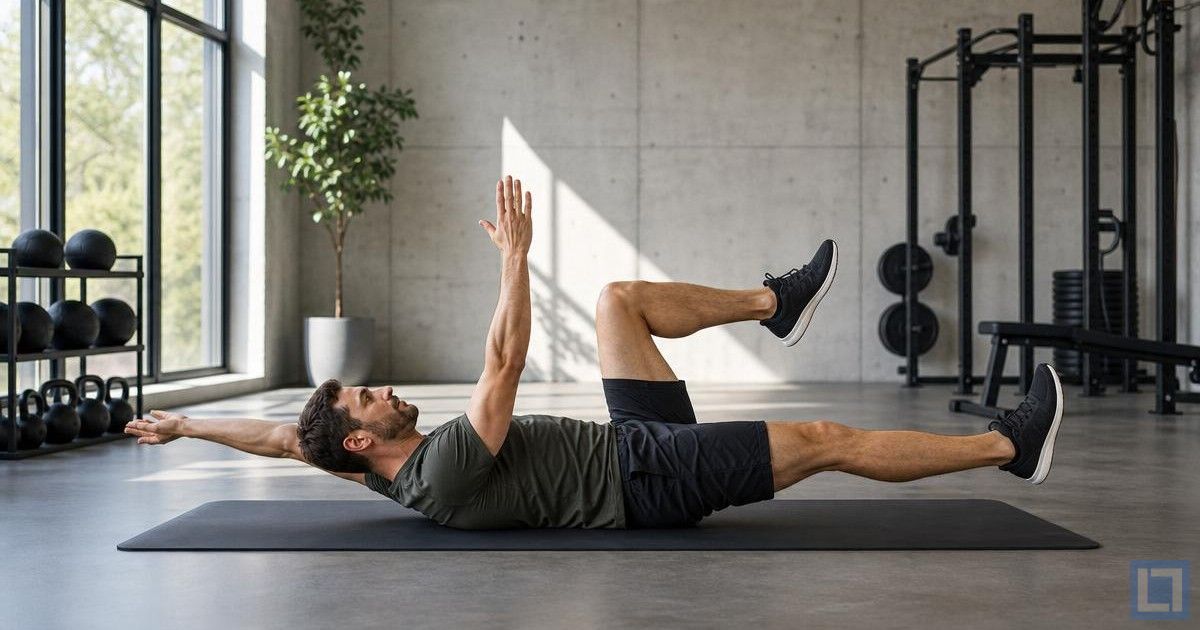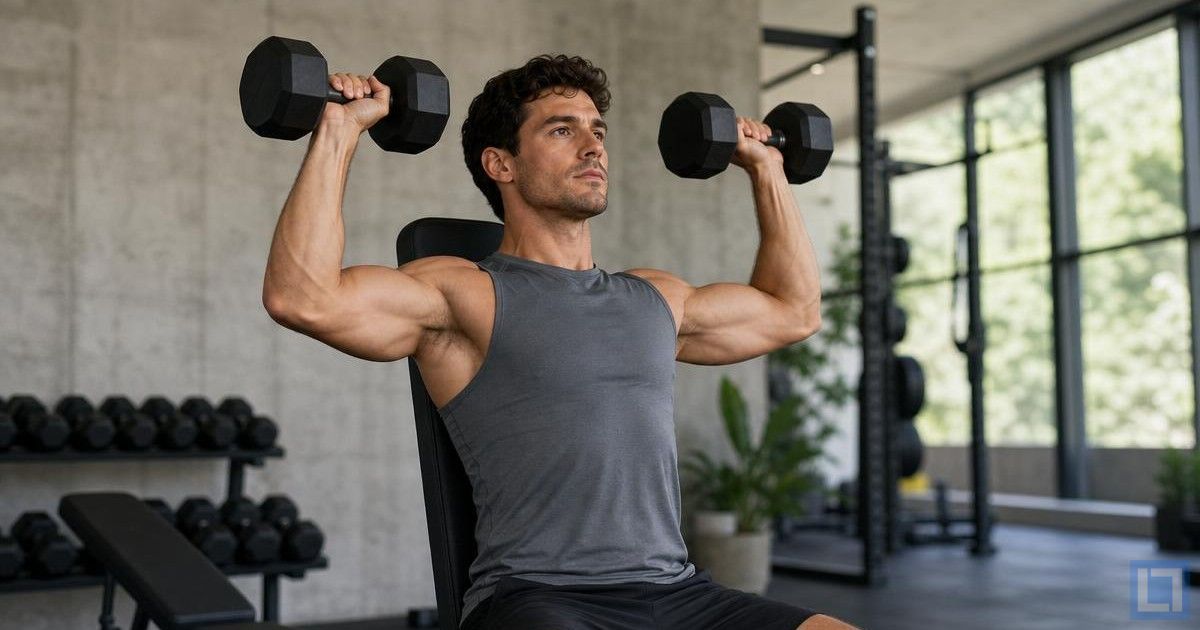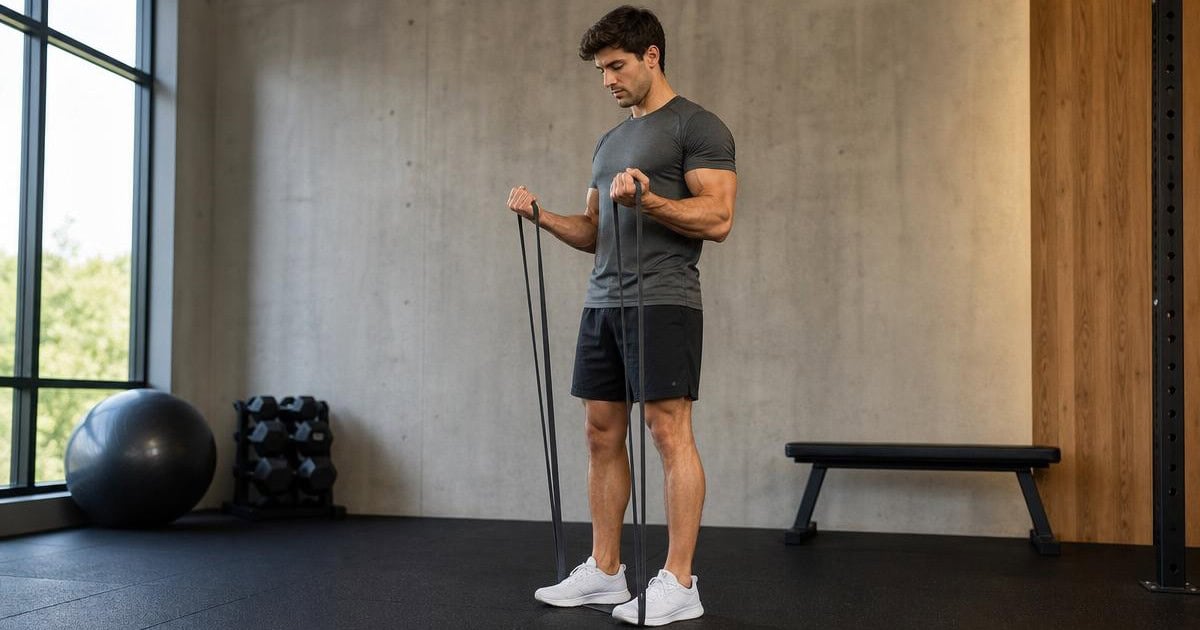
Resistance band bicep training produces real bicep development through patterns that load the biceps effectively without weights: band curl variations for compound mass loading, hammer curls for combined biceps and brachialis work, concentration curls for unilateral isolation, preacher curls for stretched-position loading, and reverse curls for forearm and brachialis emphasis. The format works particularly well for biceps because bands deliver progressive resistance that increases through the concentric phase (when biceps are most mechanically advantaged at peak contraction), accessible loading for home or travel training, and the unilateral loading capacity needed for balanced bicep development. Most lifters who consistently train resistance band bicep work 1 to 2 times per week alongside compound pulling movements (or even alone for home-only training) see measurable bicep development, improved arm pump, better elbow stability, and stronger pulling capacity within 8 to 12 weeks. The combination of standard curls, grip variations, preacher work, and unilateral isolation produces broader bicep development than equipment-limited training would suggest.
Below are ten effective resistance band bicep exercises that cover compound mass loading (band biceps curl, band 45 degrees biceps curl, band close grip biceps curl), grip variations (band hammer curl, band reverse curl), unilateral isolation (band concentration curl, band alternating biceps curl, band one arm overhead biceps curl), preacher work (band kneeling preacher curl), and unique-angle work (band cross chest biceps curl). Together they form a complete band bicep program that hits the biceps through every available band pattern. A 20 to 30-minute session pulled from this list, performed 1 to 2 times per week, produces strong bicep development for home or travel-friendly training.
Band Biceps Curl

The Band Biceps Curl performs standard biceps curls with a resistance band anchored under the feet and gripped with both hands. The pattern produces strong biceps loading with progressive band tension that increases through the curl.
For resistance band bicep training, the band biceps curl is the foundational mass-building exercise. The pattern hits the biceps through pure elbow flexion with progressive band tension. Run it for 4 sets of 10 to 15 reps as primary mass work in any band bicep session.
Stand on the middle of a resistance band with feet hip-width and grip the band ends with both hands at the sides, palms facing forward. Keep elbows pinned to the sides. Curl the hands up by flexing the elbows until the bands reach the shoulders against the band tension. Squeeze the biceps hard at the top. Lower under control. The progressive band tension increases through the curl, producing strong peak contraction loading.
Band Hammer Curl

The Band Hammer Curl performs hammer curls with a resistance band, palms facing each other (neutral grip) throughout. The neutral grip emphasizes the brachioradialis (forearm) and brachialis (under the biceps) along with the biceps.
For resistance band bicep training, the hammer curl produces combined biceps, brachialis, and forearm loading. The neutral grip recruits different muscles than standard curls. Run it for 3 sets of 10 to 12 reps as combined biceps and forearm work.
Stand on the middle of a resistance band with feet hip-width. Grip the band ends with both hands at the sides, palms facing each other (neutral grip). Keep elbows pinned to the sides. Curl the hands up by flexing the elbows while maintaining the neutral grip throughout. Squeeze at the top. Lower under control. The neutral grip emphasizes the brachialis and brachioradialis along with the biceps.
Band Concentration Curl

The Band Concentration Curl performs concentration curls with a resistance band anchored under one foot and the elbow braced against the inside of the same-side thigh. The pattern produces strong unilateral biceps isolation.
For resistance band bicep training, the concentration curl produces strong unilateral biceps isolation. The braced elbow position eliminates compensation for clean biceps loading. Run it for 3 sets of 10 to 12 reps per arm as unilateral biceps isolation work.
Sit on a bench or sturdy chair. Stand on the band with one foot. Lean forward and grip the band end with the same-side hand, palm facing up. Brace the elbow against the inside of the same-side thigh. Curl the hand up by flexing the elbow while keeping the elbow braced against the thigh. The braced position produces clean biceps isolation. Lower under control. Switch sides between sets.
Band Reverse Curl

The Band Reverse Curl performs biceps curls with palms facing down (overhand grip) throughout. The reverse grip shifts loading to the brachialis and brachioradialis, building the muscles that contribute to upper-forearm thickness.
For resistance band bicep training, the reverse curl is one of the most effective brachialis exercises that exists. The brachialis pushes the biceps up, contributing to upper-arm thickness. Run it for 3 sets of 10 to 12 reps as combined brachialis and forearm work.
Stand on the middle of a resistance band with feet hip-width. Grip the band ends with both hands at the sides, palms facing back (overhand grip). Keep elbows pinned to the sides. Curl the hands up by flexing the elbows while maintaining the overhand grip throughout. Squeeze at the top. Lower under control. Use lighter resistance than standard biceps curls because the reverse grip is mechanically weaker.
Band Kneeling Preacher Curl

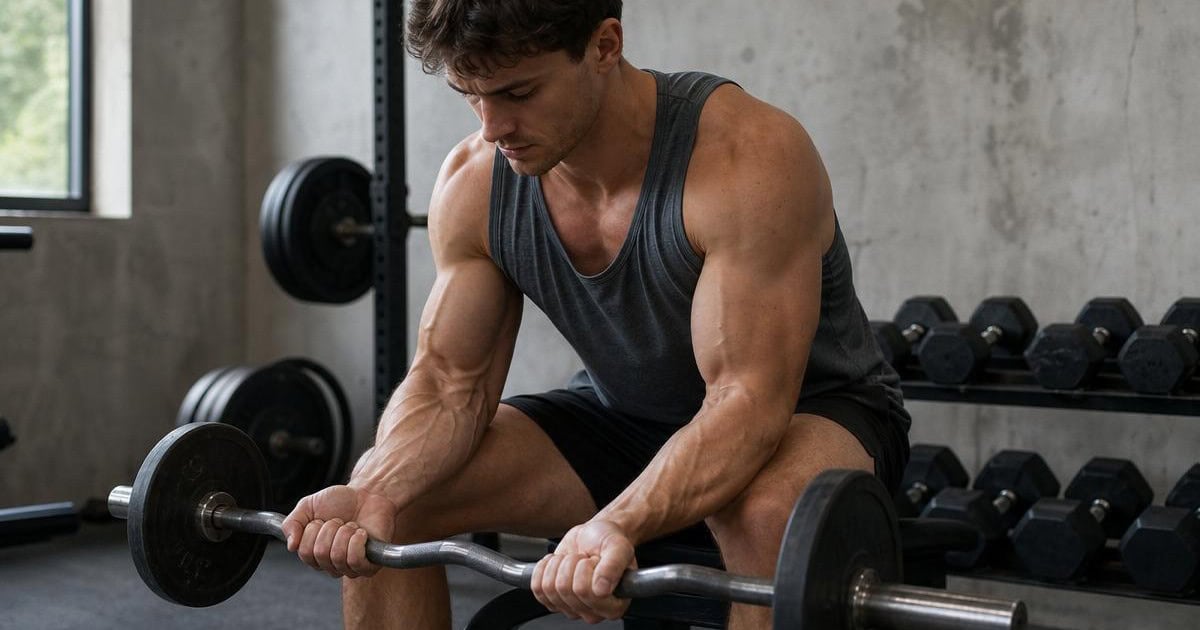
The Band Kneeling Preacher Curl performs preacher curls with a resistance band, kneeling with the upper arms braced over a bench in preacher position. The pattern produces strong biceps stretch loading through the preacher angle.
For resistance band bicep training, the kneeling preacher curl produces strong biceps stretch loading. The preacher position emphasizes the lower biceps through stretched-position work. Run it for 3 sets of 10 to 12 reps as biceps stretch and isolation work.
Position a bench with the back inclined or use a preacher curl bench. Anchor a resistance band to a sturdy low support in front of the bench. Kneel behind the bench with the upper arms draped over the angled back, palms facing up. Grip the band ends. Curl the hands up by flexing the elbows. The preacher position eliminates upper-body compensation and produces strong stretched-position biceps loading at the bottom.
Band Cross Chest Biceps Curl

The Band Cross Chest Biceps Curl performs alternating biceps curls where the curling hand crosses toward the opposite shoulder. The cross-body motion emphasizes the biceps from a unique angle.
For resistance band bicep training, the cross chest biceps curl produces unique-angle biceps loading. The cross-body motion hits the biceps differently than standard curls. Run it for 3 sets of 10 to 12 reps per arm as biceps variation work.
Stand on the middle of a resistance band with feet hip-width. Grip the band ends with both hands at the sides. Curl one hand up while crossing it toward the opposite shoulder (the right hand curls toward the left shoulder). Squeeze at the top. Lower under control while alternating to the other arm. The cross-body motion produces unique biceps loading angle.
Band Alternating Biceps Curl

The Band Alternating Biceps Curl performs alternating curls with one arm at a time. The alternating pattern allows greater concentration on each arm individually and increases time under tension.
For resistance band bicep training, the alternating curl produces strong unilateral biceps work. The alternating pattern allows greater concentration per arm. Run it for 3 sets of 10 to 12 reps per arm as alternating biceps work.
Stand on the middle of a resistance band with feet hip-width. Grip the band ends with both hands at the sides, palms facing forward. Curl one hand up by flexing the elbow until the band reaches the shoulder. Lower under control. As one hand returns to starting, begin curling the other hand. Continue alternating in a smooth rhythm. The alternating pattern produces consistent biceps loading per arm.
Band Close Grip Biceps Curl

The Band Close Grip Biceps Curl performs biceps curls with a narrow grip (hands close together). The close grip emphasizes the long head (outer) of the biceps along with the brachialis.
For resistance band bicep training, the close grip curl emphasizes the biceps long head and brachialis. The narrow grip recruits different fibers than wide-grip variants. Run it for 3 sets of 10 to 12 reps as long-head emphasis work.
Stand on the middle of a resistance band with feet hip-width. Grip the band ends with both hands close together (palms facing forward, hands within 4 to 6 inches of each other). Keep elbows pinned to the sides. Curl the hands up by flexing the elbows. Squeeze at the top. Lower under control. The close grip produces stronger long-head and brachialis recruitment.
Band One Arm Overhead Biceps Curl

The Band One Arm Overhead Biceps Curl performs unilateral biceps curls with the working arm extended overhead. The overhead position produces unique biceps loading through stretched-position work.
For resistance band bicep training, the overhead biceps curl produces unique-angle stretched biceps loading. The overhead position hits the long head of the biceps specifically through stretched-position work. Run it for 3 sets of 8 to 10 reps per arm as advanced biceps variation work.
Stand on the middle of a resistance band with feet hip-width. Grip one end of the band with one hand and extend the arm fully overhead. The other hand grips the band at the side or behind the back to pin it. From the overhead position, bend the elbow to curl the band toward the back of the head while keeping the upper arm vertical. Extend the arm back to overhead by straightening the elbow. The overhead position produces strong long-head loading.
Band 45 Degrees Biceps Curl

The Band 45 Degrees Biceps Curl performs biceps curls with the body leaned forward at about 45 degrees. The lean shifts the biceps loading angle, producing emphasis on the lower biceps.
For resistance band bicep training, the 45-degree curl produces unique biceps loading through leaned-forward positioning. The pattern hits the biceps at a different angle than standard upright curls. Run it for 3 sets of 10 to 12 reps as biceps variation work.
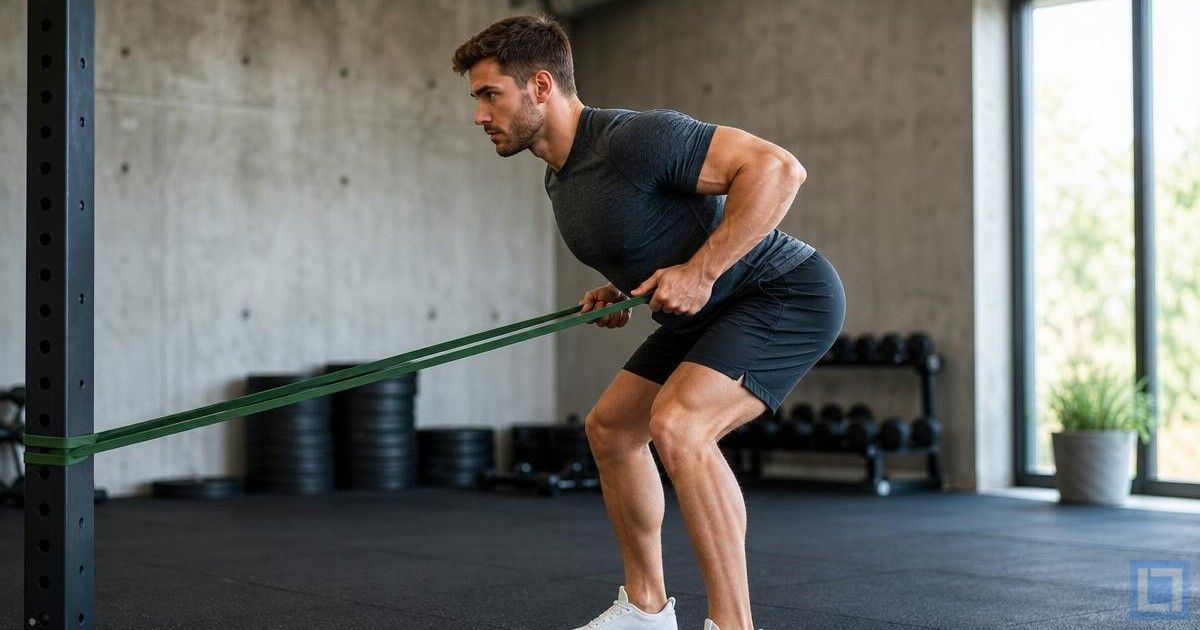
Stand on the middle of a resistance band with feet hip-width. Grip the band ends with both hands. Hinge forward at the hips to about 45 degrees while keeping the back flat. Let the arms hang straight down with palms facing forward. Curl the hands up by flexing the elbows. Squeeze at the top. Lower under control. The forward-leaning position produces unique biceps loading, particularly on the lower biceps near the elbow.
How To Program These Workouts
A productive resistance band bicep session pulls 5 to 6 exercises from the list above based on training goals. A common balanced session: band biceps curl (mass), band hammer curl (variation), band concentration curl (isolation), band reverse curl (brachialis and forearm), band kneeling preacher curl (stretch). For home-based focus: band biceps curl, band hammer curl, band alternating biceps curl, band close grip biceps curl, band 45 degrees biceps curl. Run mass work for 3 to 4 sets of 10 to 15 reps, hammer curl variations for 3 sets of 10 to 12 reps, isolation work for 3 sets of 10 to 12 reps per arm, and preacher curls for 3 sets of 10 to 12 reps. Total session covers 14 to 18 working sets focused on bicep development.
Train resistance band bicep work 1 to 2 times per week as part of broader pulling-day or home-training programming. Bands work particularly well for travel, home gyms, and rehab/prehab work because they provide progressive resistance without heavy weights. Most successful programs include band bicep work either: 1) at the end of a back day (after compound pulls), 2) on a dedicated arm day with tricep work, or 3) as a complete bicep session for home-only training. Keep training time under 25 to 30 minutes per session. Progress through bands by upgrading to heavier bands or doubling up bands as strength builds.
For broader arm programming, see our how to build bigger biceps and best at home arm workouts. For specific home work, see our best at home bicep workouts.
Final Thoughts
The best resistance band bicep workouts deliver real bicep development through patterns that effectively load the biceps without barbells or dumbbells. The combination of compound mass work, grip variations, unilateral isolation, preacher work, and unique-angle exercises covers every functional pattern of the biceps and produces broader development than equipment-limited training would suggest. For lifters who want to train biceps effectively at home or on the road, want to add band-specific peak contraction tension to existing programs, want to address muscle imbalances through unilateral work, or want to break through plateaus in bicep development, dedicated resistance band bicep training is one of the most effective options available.
Stay focused on band selection and elbow position. The most common resistance band bicep training mistakes include using bands that are too light (which produces insufficient loading for growth) and letting the elbows drift forward during curls (which shifts work from biceps to shoulders and front delts). The fix: progress to medium and heavy bands as strength allows (most lifters can use medium to heavy bands for compound bicep work), and keep the elbows pinned to the sides throughout every curl to maintain biceps loading. Quality reps with proper elbow position produce stronger bicep development than ego-driven heavy bands with sloppy form.
Frequently Asked Questions
Are resistance bands effective for biceps?
Yes very effectively. Resistance bands produce real bicep development through compound curl variations (standard, hammer, reverse), unilateral isolation (concentration, alternating, overhead), preacher work, and unique-angle variations. The progressive band tension produces strong peak contraction loading that drives growth. Many lifters build excellent biceps through dedicated band training. Most successful programs include bands alongside dumbbells when both are accessible, but bands alone can produce strong bicep development for lifters with limited equipment access.
Can resistance bands replace dumbbell curls?
For some lifters yes, for others as a complement. Bands produce real biceps loading through progressive tension that mirrors many dumbbell curl loading patterns plus add the constant-tension peak contraction that bands provide better than dumbbells. Lifters who can not access dumbbells (home training, travel, recovery from injury) can build excellent biceps through dedicated band training combined with chin-ups (when available). Lifters with full equipment access typically include both for maximum development. The key is progressive overload through heavier bands or doubled bands over time.
How heavy should bands be for biceps?
Medium to heavy for most exercises. The biceps respond best to challenging loading. Most successful resistance band bicep programs use medium to heavy bands (25 to 60 pounds of resistance) for compound work like band biceps curls and hammer curls, and lighter bands (15 to 30 pounds) for isolation work like concentration curls. Use bands that allow strict form across the working rep range; if reps become easy, upgrade to heavier bands or double up bands.
How often should I train biceps with bands?
One to two band bicep sessions per week works for most lifters. The biceps recover reasonably quickly but accumulate fatigue from compound pulling work (rows, pull-ups, chin-ups) that already activates them substantially. Most successful programs include band bicep work either at the end of a back day, on a dedicated arm day, or twice per week with one heavier session and one lighter pump-focused session. Three or more weekly heavy bicep sessions typically produces overuse issues rather than accelerated growth.
What’s the most effective resistance band bicep exercise?
The band biceps curl is the most foundational and effective for most lifters. The pattern produces strong compound bicep loading through full range of motion with progressive band tension that increases through the curl. Most successful programs include band biceps curls as primary mass work. Other strong choices include band hammer curls (combined biceps and forearm), band concentration curls (unilateral isolation), and band reverse curls (brachialis and forearm). Most successful programs include 4 to 6 different exercises per session.