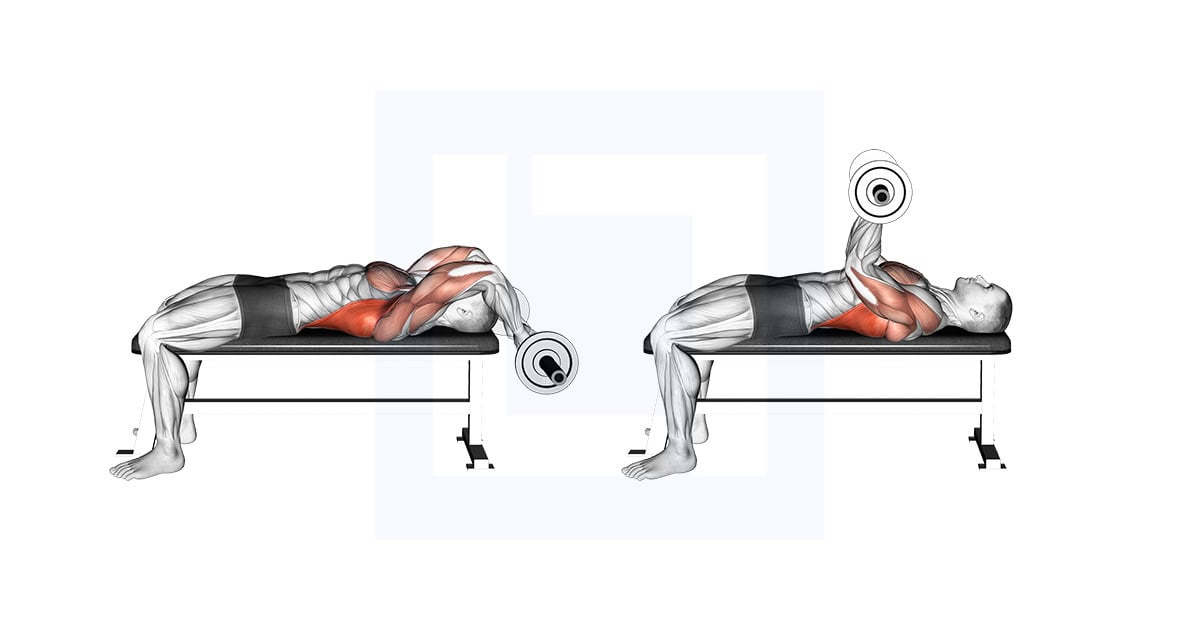
Dumbbell Decline Fly

Description
The dumbbell decline fly is a chest isolation exercise performed on a decline bench with a dumbbell in each hand. The decline angle biases the lower (sternal) head of the pectoralis major, building lower-chest thickness that flat or incline work may miss. It is an effective finisher for complete chest development.
Muscle Group
Equipment Required
Dumbbell Decline Fly Instructions
- Set an adjustable bench to a decline of roughly 15 to 30 degrees. Lock your feet under the leg pads.
- Lie back with a dumbbell in each hand. Press the dumbbells up over your lower chest with arms extended, palms facing each other.
- Pull your shoulders down and back into the bench. Lift your chest. Brace your core.
- Set a slight bend in your elbows and lock that angle in throughout the movement.
- Lower both dumbbells out to your sides in a wide arc. Keep the slight elbow bend fixed.
- Continue lowering until you feel a strong stretch in your chest. Stop before any shoulder discomfort.
- Reverse the arc by squeezing your chest to bring the dumbbells back together over your lower chest.
- Squeeze your chest hard at the top. Repeat for the desired number of reps.
Dumbbell Decline Fly Form & Visual

Dumbbell Decline Fly Benefits
- Targets the lower (sternal) chest with a deep stretch
- Builds lower-chest thickness
- Provides a peak contraction at the top that pressing misses
- Often easier on the shoulders than flat fly variations
- Useful variation in a complete chest program
- Excellent finisher after decline pressing
Dumbbell Decline Fly Muscles Worked
- Pectoralis major (especially the sternal/lower head)
- Anterior deltoid (reduced involvement vs flat fly)
- Biceps brachii (stabilizer)
- Serratus anterior
Dumbbell Decline Fly Variations & Alternatives
- Dumbbell Fly (flat)
- Dumbbell Incline Fly
- Cable Decline Fly
- Dumbbell Floor Fly
- Single-Arm Dumbbell Decline Fly
- Pause Dumbbell Decline Fly
- Tempo Dumbbell Decline Fly