Dumbbell Upright Shoulder External Rotation

Description
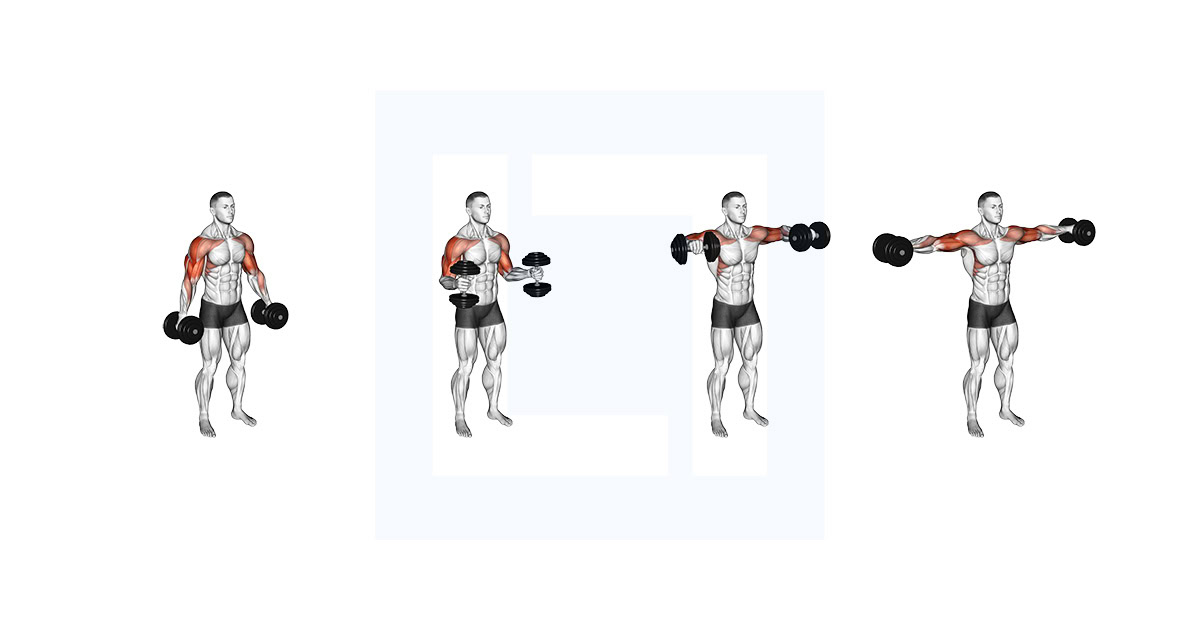
The dumbbell upright shoulder external rotation is a rotator cuff strengthening exercise where you stand with your elbow at your side, bent at 90 degrees, and rotate a dumbbell outward. It directly targets the infraspinatus and teres minor — the primary external rotators of the shoulder. It is one of the most important prehabilitation exercises for shoulder health.
Muscle Group
Equipment Required
Dumbbell Upright Shoulder External Rotation Instructions
- Stand tall with a light dumbbell in your right hand. Bend your right elbow to 90 degrees with your forearm pointing forward.
- Pin your right elbow against your right side. Place a rolled towel between your elbow and ribs if needed.
- Pull your shoulders back and down. Brace your core.
- Rotate your forearm outward (away from your body) by externally rotating at the shoulder. Keep your elbow pinned.
- Continue rotating until your forearm points roughly 45 to 60 degrees outward from the starting position.
- Slowly rotate back to the start position over two seconds. Control the descent.
- Complete all reps on the right, then switch. Use very light weight (2 to 8 lbs) and higher reps (15 to 25).
- This is a prehab exercise — do not use heavy weight. Smooth, controlled reps are the priority.
Dumbbell Upright Shoulder External Rotation Form & Visual

Dumbbell Upright Shoulder External Rotation Benefits
- Directly strengthens the rotator cuff (infraspinatus and teres minor)
- Essential for shoulder health and injury prevention
- Helps prevent impingement and rotator cuff tears
- Excellent warm-up before pressing exercises
- Improves shoulder stability for all overhead movements
- Works at home with a very light dumbbell
Dumbbell Upright Shoulder External Rotation Muscles Worked
- Infraspinatus
- Teres minor
- Posterior deltoid (secondary)
Dumbbell Upright Shoulder External Rotation Variations & Alternatives
- Dumbbell Lying External Shoulder Rotation
- Cable Standing Shoulder External Rotation
- Band External Rotation
- Cable External Rotation at 90 Degrees
- Side-Lying External Rotation
- Internal Rotation (opposite movement)
- Band Upright Shoulder External Rotation
- Dumbbell External Rotation
- Suspender Shoulder External Rotation
- Dumbbell Seated External Rotation