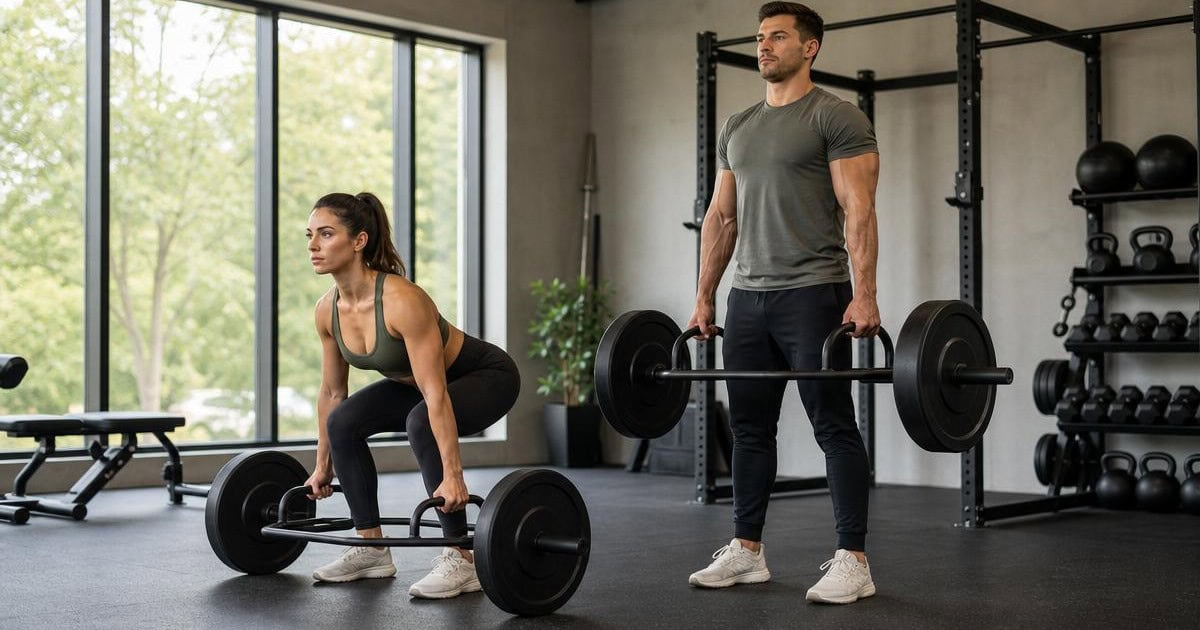
Barbell trap training produces real trap development through patterns that load the traps with the unique advantages barbells offer: heavy bilateral loading for compound shrug variations (standard, behind-back, snatch grip, wide grip, power) that produce strong upper trap development through scapular elevation, compound pulling patterns (deadlift, rack pull, Pendlay row) that produce extreme heavy loading and full trap activation, dynamic pulling patterns (upright row) for combined trap and side delt work, and athletic explosive patterns (clean and press, power shrug) for combined trap and full-body power work. The format works particularly well for traps because the muscle group’s primary function (scapular elevation under load) responds extremely well to heavy bilateral barbell loading that dumbbells cannot match for compound mass work, and barbells deliver dedicated patterns for direct trap isolation through shrug variations and compound trap activation through deadlift variations. Most lifters who consistently train barbell trap work 1 to 2 times per week alongside compound pulling movements (or even alone for upper-back-focused training) see measurable trap development, improved deadlift performance through stronger traps holding heavy loads, better posture through dedicated trap mass, stronger overall upper back, and stronger neck/upper trap appearance within 8 to 12 weeks. The combination of shrug variations, heavy compound pulls, and athletic explosive patterns produces broader trap development than dumbbell-only programs.
Below are ten effective barbell trap exercises that cover shrug variations (barbell shrug, barbell behind the back shrug, barbell standing snatch grip shrug, barbell wide shrug, barbell power shrug), heavy compound pulls (barbell deadlift, barbell rack pull, barbell Pendlay row), upright row (barbell upright row), and athletic explosive work (barbell clean and press). Together they form a complete barbell trap program. A 25 to 35-minute session pulled from this list, performed 1 to 2 times per week, produces strong trap development for any commercial gym or garage gym training.
Barbell Shrug

The Barbell Shrug performs shrugs with a barbell held in front of the body. The pattern produces foundational compound upper trap mass work through pure scapular elevation.
For barbell trap training, the barbell shrug is the foundational compound trap exercise. The pattern hits the upper traps directly through scapular elevation. Run it for 4 sets of 8 to 12 reps as primary trap mass work in any barbell trap session.
Stand with feet hip-width holding a barbell at the front of the thighs with overhand grip slightly wider than shoulder-width. Shrug the shoulders straight up by elevating the scapulae as high as possible toward the ears. The upper traps work hard through pure scapular elevation. Squeeze the upper traps hard at peak elevation (hold briefly for additional contraction). Lower the shoulders under control to fully depressed position. The pattern is foundational for compound trap mass and produces substantial upper trap development through heavy bilateral loading.
Barbell Behind the Back Shrug

The Barbell Behind the Back Shrug performs shrugs with a barbell held behind the body. The behind-back position emphasizes the upper traps differently than front shrugs.
For barbell trap training, the behind the back shrug produces unique upper trap loading. The behind-back position changes the angle. Run it for 3 sets of 10 to 12 reps as variation upper trap work.
Stand with feet hip-width with a barbell on a rack at hip height behind the body. Grip the bar with overhand grip slightly wider than shoulder-width. Unrack the bar by extending the body so it hangs at the back of the thighs. Shrug the shoulders straight up by elevating the scapulae. The upper traps work through scapular elevation. The behind-back position emphasizes the upper traps differently than front shrugs and produces unique loading. Squeeze hard at peak elevation. Lower under control. The pattern produces variation trap work.
Barbell Upright Row

The Barbell Upright Row performs upright rows with a barbell. The pattern produces combined upper trap, side delt, and bicep work through vertical pulling motion.
For barbell trap training, the upright row produces combined trap and side delt work. The pattern hits both upper traps and lateral delts. Run it for 3 to 4 sets of 8 to 12 reps as combined upper trap work.
Stand with feet hip-width holding a barbell at the front of the thighs with overhand grip. The grip width depends on focus – shoulder-width or slightly inside emphasizes traps more, wider emphasizes side delts more. Pull the barbell straight up along the body by lifting the elbows high. The bar travels vertically up to about shoulder height. The upper traps work through the elevation while the side delts work through the lateral lift. Squeeze hard at peak contraction. Lower under control. Avoid pulling too high which can stress the shoulders.
Barbell Rack Pull

The Barbell Rack Pull performs partial deadlifts from a rack at knee height. The pattern produces extreme upper trap and back loading through heavy compound pulling.
For barbell trap training, the rack pull produces extreme heavy compound trap and back work. The shortened range allows extremely heavy loading. Run it for 3 to 4 sets of 5 to 8 reps as heavy compound trap work.
Set up a barbell on a rack at about knee height. Stand in front of the bar with feet hip-width. Hinge at the hips and grip the bar with overhand or mixed grip slightly wider than shoulder-width. Drive the hips forward to stand fully tall by extending the hips. The shortened range from knee height to lockout allows for extremely heavy loading. The upper traps work extraordinarily hard through the heavy load while the back, glutes, and hamstrings drive the lockout. Squeeze the traps at the top. Lower under control. The pattern produces heavy compound trap mass work.
Barbell Deadlift

The Barbell Deadlift performs conventional deadlifts. The pattern produces foundational compound posterior chain work plus extreme upper trap and grip activation.
For barbell trap training, the deadlift produces compound trap activation through heavy loading. The pattern hits traps as part of full-body lifting. Run it for 3 to 4 sets of 5 to 8 reps as compound trap work.
Stand with feet hip-width with a barbell on the floor over the mid-foot. Hinge at the hips and grip the bar with overhand or mixed grip just outside the legs. Drive through the heels to stand fully tall by extending the hips and knees simultaneously. The upper traps work extraordinarily hard isometrically to support the heavy bar through the entire lift while the back, glutes, hamstrings, and quads drive the motion. The traps work particularly hard at the lockout. Lower under control by hinging back at the hips.
Barbell Pendlay Row

The Barbell Pendlay Row performs explosive bent-over rows from a dead-stop on the floor. The pattern produces strong upper back and trap loading through explosive pulling.
For barbell trap training, the Pendlay row produces strong explosive upper back and trap work. The dead-stop pattern adds explosive element. Run it for 3 sets of 6 to 8 reps as explosive upper back/trap work.
Stand with a barbell on the floor over the mid-foot. Hinge forward at the hips with a flat back so the torso is parallel to the floor. Grip the bar with overhand grip slightly wider than shoulder-width. Explosively pull the bar to the lower chest by retracting the shoulder blades and pulling the elbows high. The upper traps work hard through the retraction while the upper back works through the row. Lower the bar all the way back to the floor for a complete dead stop. The pattern produces strong upper back and trap work with explosive character.
Barbell Clean and Press

The Barbell Clean and Press performs the clean and press combination with a barbell. The pattern produces compound full-body explosive work plus extreme trap activation.
For barbell trap training, the clean and press produces compound full-body work plus heavy trap loading. The pattern hits traps through multiple phases. Run it for 3 sets of 5 to 8 reps as compound athletic trap work.
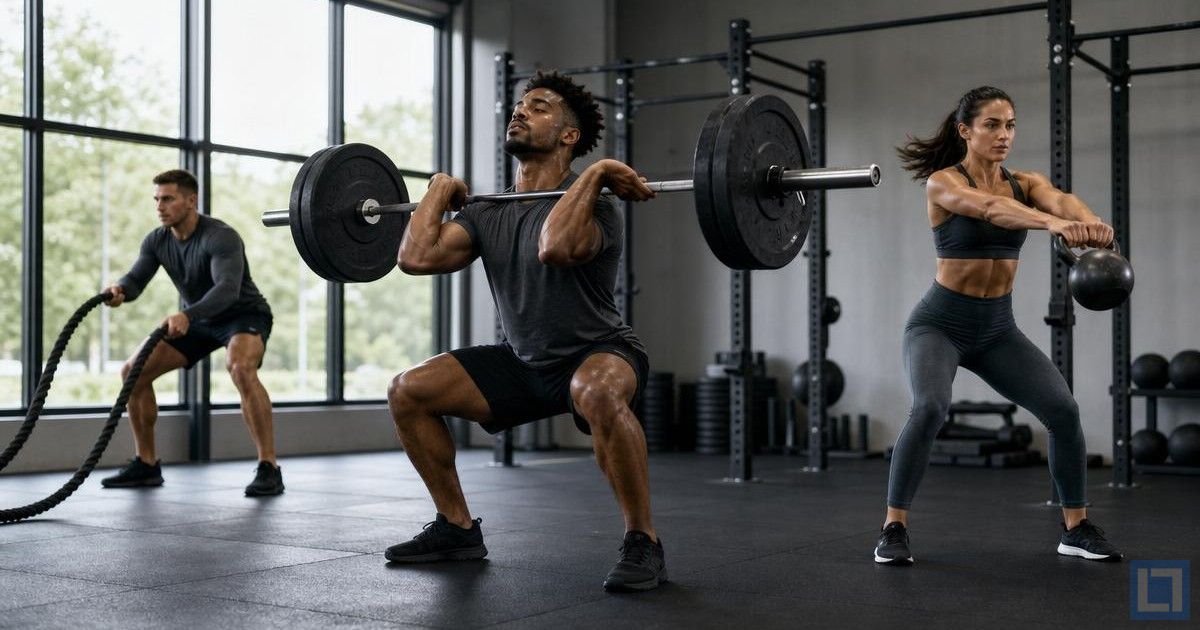
Stand with a barbell on the floor. Hinge at the hips and grip the bar with overhand grip at shoulder-width. Drive the hips forward explosively to extend the body fully tall, pulling the bar up. The traps work hard through the extension and shrug phases. As the bar rises, drop under it slightly and catch it at the shoulders in the rack position. From the rack, press the bar overhead. The traps work through the press as well. Lower back to the floor under control. The pattern produces compound full-body explosive trap work.
Barbell Standing Snatch Grip Shrug

The Barbell Standing Snatch Grip Shrug performs shrugs with a wide snatch grip. The wide grip emphasizes the upper traps and rhomboids through unique angle loading.
For barbell trap training, the snatch grip shrug produces unique trap loading through wide grip. The angle creates different loading. Run it for 3 sets of 8 to 12 reps as variation trap work.
Stand with feet hip-width holding a barbell at the front of the thighs with overhand snatch grip (significantly wider than shoulder-width, almost at the bar plates). Shrug the shoulders straight up by elevating the scapulae. The wide snatch grip changes the loading angle on the upper traps and adds rhomboid involvement. The traps work through scapular elevation with the wide grip emphasizing the muscle differently than standard shrugs. Squeeze hard at peak elevation. Lower under control. The pattern produces variation trap work.
Barbell Wide Shrug

The Barbell Wide Shrug performs shrugs with a wide grip and a barbell. The wide grip changes the trap loading angle.
For barbell trap training, the wide shrug produces upper trap work with variation. The wide grip adds variety. Run it for 3 sets of 8 to 12 reps as variation upper trap work.
Stand with feet hip-width holding a barbell at the front of the thighs with overhand grip wider than standard shoulder-width (but narrower than snatch grip). Shrug the shoulders straight up by elevating the scapulae. The upper traps work through the shrug with the wide grip creating slightly different loading compared to narrow grip shrugs. Squeeze hard at peak elevation. Lower under control. The wide grip produces variation in trap loading and adds variety to upper trap training. Use as accessory variation work alongside standard barbell shrugs.
Barbell Power Shrug

The Barbell Power Shrug performs explosive shrugs with leg drive. The pattern combines lower-body drive with upper trap shrug for compound power work.
For barbell trap training, the power shrug produces explosive compound trap work. The leg drive adds athletic element. Run it for 3 sets of 5 to 8 reps as explosive compound trap work.
Stand with feet hip-width holding a barbell at the front of the thighs with overhand grip. Bend the knees slightly to dip. Drive explosively up through the legs while shrugging the shoulders up at the same time. The leg drive provides initial momentum while the upper traps work through scapular elevation at the top. The combined motion produces extreme power and allows for heavier loading than strict shrugs. Lower under control. The pattern is athletic and produces strong combined trap and full-body power work. Use only after building solid strict shrug strength.
How To Program These Workouts
A productive barbell trap session pulls 4 to 6 exercises from the list above based on training goals. A common balanced session: barbell shrug (compound mass), barbell rack pull (heavy compound), barbell upright row (combined), barbell behind the back shrug (variation), barbell power shrug (explosive). For mass focus: barbell shrug, barbell rack pull, barbell deadlift, barbell power shrug. For variation focus: barbell behind the back shrug, barbell standing snatch grip shrug, barbell wide shrug. For athletic focus: barbell clean and press, barbell power shrug, barbell Pendlay row. Run shrug work for 3 to 4 sets of 8 to 12 reps, heavy compound pulls for 3 to 4 sets of 5 to 8 reps, upright rows for 3 sets of 8 to 12 reps, and explosive work for 3 sets of 5 to 8 reps. Total session covers 12 to 18 working sets focused on trap development.
Train barbell trap work 1 to 2 times per week as part of broader pulling-day or upper-back-focused programming. The traps recover reasonably quickly but accumulate fatigue from compound pulling work that activates them substantially (every deadlift, row, and pull-up activates the traps significantly). Most successful programs include barbell trap work either: 1) on a dedicated upper-back day with traps as primary focus, 2) at the end of a back day after compound pulling, or 3) as part of a complete pulling-day program. Most successful programs alternate between heavy shrug days and lighter explosive shrug days for variety.
For broader trap programming, see our best trap workouts and how to build bigger traps. For specific barbell work, see our best barbell workouts.
Final Thoughts
The best barbell trap workouts deliver real trap development through patterns that effectively load the traps with the unique advantages barbells offer: heavy bilateral loading for compound shrug variations, dedicated patterns for varying grip widths and positions, heavy compound pulls for trap activation, and athletic explosive patterns for combined trap and full-body power. The combination of shrug variations (standard, behind-back, snatch grip, wide), heavy compound pulls (deadlift, rack pull, Pendlay row), upright rows, and explosive patterns (clean and press, power shrug) covers every functional pattern of the traps and produces broader development than dumbbell-only training would suggest. The barbell rack pull in particular produces some of the most effective heavy trap loading possible due to the heavy bilateral loading capacity. For lifters who want elite trap mass through heavy compound loading, want stronger deadlifts through stronger traps, want to build athletic explosive trap power through clean and press variations, or want to break through trap plateaus through dedicated barbell loading, dedicated barbell trap training is one of the most effective options available.
Stay focused on full range of motion and proper scapular elevation. The most common barbell trap training mistakes include using partial range of motion on shrugs (which limits trap loading) and rolling the shoulders forward and back during shrugs (which reduces effective trap loading and risks shoulder strain). The fix: complete every shrug rep with full range from fully depressed scapulae at the bottom to fully elevated at the top, and shrug straight up without rolling the shoulders forward or backward. Quality reps with proper scapular elevation produce stronger trap development with reduced injury risk.
Frequently Asked Questions
Are barbell shrugs effective for traps?
Yes the foundational compound trap exercise. Barbell shrugs produce strong upper trap loading through pure scapular elevation with the heavy bilateral loading the barbell allows. The pattern hits the upper traps directly and is fundamental for trap mass development. Most successful trap programs include barbell shrugs as primary mass work, typically 8 to 12 reps with progressive heavy loading. Common mistake: using partial range of motion or rolling the shoulders rather than shrugging straight up. Use full range with proper form for best trap development.
Do deadlifts build traps?
Yes deadlifts produce strong trap activation. The traps work extraordinarily hard isometrically to support the heavy bar through the entire deadlift and particularly hard at the lockout where the traps must hold the bar against the body. Many lifters with strong deadlifts develop excellent trap mass simply through heavy deadlift work alone. Most successful trap programs include heavy deadlifts and rack pulls as compound trap work alongside dedicated shrug variations. The combination produces broader trap development than shrug-only programs.
Are rack pulls better than deadlifts for traps?
Different – both effective. Rack pulls allow heavier absolute loading than deadlifts due to the shortened range from knee height to lockout, which produces extreme trap loading at the heavy weights possible. Deadlifts produce trap activation through the full range of motion plus athletic transfer. Most successful programs include both: deadlifts as primary compound posterior chain work and rack pulls as heavy compound trap work. The combination produces stronger trap development than either alone, particularly for advanced lifters seeking heavy trap loading.
How heavy should barbells be for traps?
Heavy for shrugs and compound pulls. Barbell shrugs use heavy weights (men: 135 to 315+ lb; women: 65 to 155+ lb). Behind-the-back shrugs use moderate to heavy weights (slightly less than front shrugs due to grip mechanics). Rack pulls use very heavy weights (men: 315 to 600+ lb; women: 155 to 300+ lb). Upright rows use moderate weights (men: 65 to 135 lb; women: 35 to 65 lb). Most successful programs progressively load all exercises until the working rep range becomes challenging. Traps tolerate and respond to very heavy loading.
How often should I train traps with barbells?
One to two barbell trap sessions per week works for most lifters. The traps recover reasonably quickly but accumulate fatigue from compound pulling work that activates them substantially. Most successful programs include barbell trap work either on a dedicated upper-back day, at the end of a back day, or as part of a complete pulling-day program. Note that heavy deadlift days inherently train the traps significantly even without dedicated shrug work. Three or more weekly heavy trap-focused sessions can produce overuse issues.