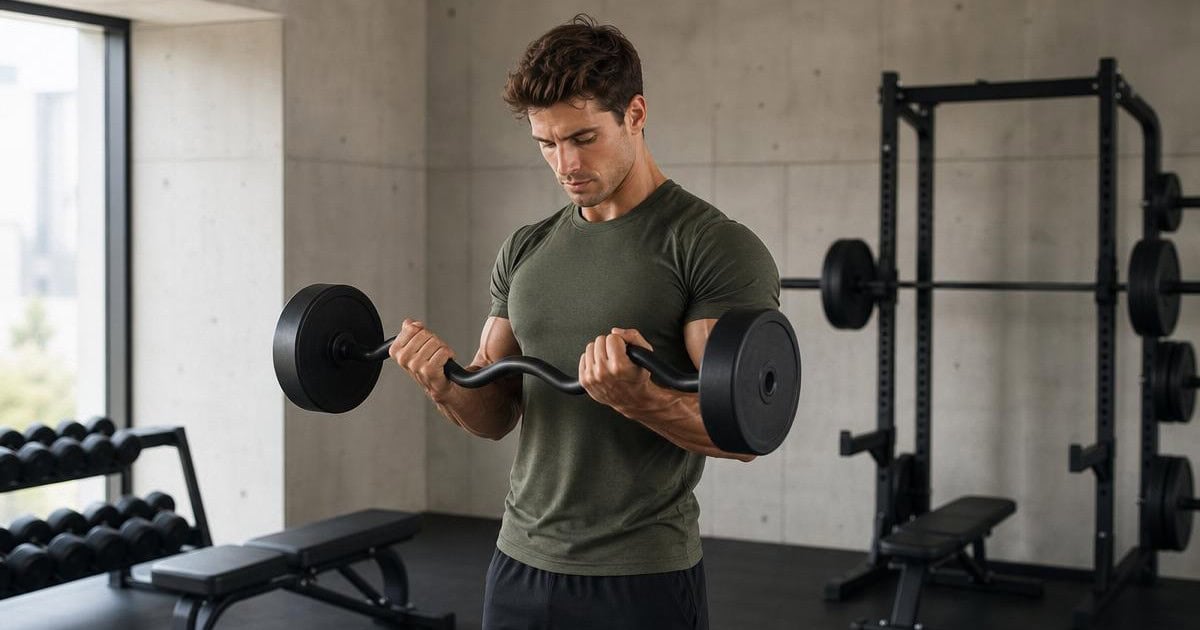
Barbell bicep training produces real bicep development through patterns that load the biceps with the unique advantages barbells offer: heavy bilateral loading capacity for compound bicep curls (standard, wide grip, close grip, reverse grip) that produce strong bicep mass through pure elbow flexion at heavier loads than dumbbells allow, strict isolation patterns (preacher curl, spider curl, lying preacher curl, strict curl) that eliminate body english through bench/wall support, varied grip widths (close, standard, wide) for different head emphasis (long head with close grip, short head with wide grip), reverse grip variations for combined bicep/brachialis development, and dynamic alternating patterns (alternate biceps curl) for combined bicep and core work. The format works particularly well for biceps because the muscle group has multiple regions (long head, short head, brachialis) that each respond well to specific barbell grip variations, and barbells deliver dedicated patterns for each region with the heavy bilateral loading that builds elite bicep mass. Most lifters who consistently train barbell bicep work 1 to 2 times per week alongside compound pulling movements see measurable bicep development, broader arm development through brachialis work, improved peak contraction loading, and stronger arms within 8 to 12 weeks. The combination of standard curls, varied grip widths, isolation patterns, and reverse grip work produces broader bicep development than dumbbell-only programs.
Below are ten effective barbell bicep exercises that cover compound curl variations (barbell curl, barbell standing close grip curl, barbell standing wide grip biceps curl, barbell standing reverse grip curl, barbell alternate biceps curl), strict isolation patterns (barbell preacher curl, barbell spider curl, barbell lying preacher curl, barbell strict curl), and unique angle work (barbell drag curl). Together they form a complete barbell bicep program. A 25 to 35-minute session pulled from this list, performed 1 to 2 times per week, produces strong bicep development for any commercial gym or garage gym training.
Barbell Curl

The Barbell Curl performs standing barbell curls. The pattern produces foundational compound bicep mass work through pure elbow flexion with heavy bilateral loading.
For barbell bicep training, the barbell curl is the foundational compound bicep exercise. The pattern hits biceps through pure elbow flexion with heavy loading. Run it for 4 sets of 6 to 10 reps as primary bicep mass work in any barbell bicep session.
Stand with feet hip-width holding a barbell at the front of the thighs with underhand (supinated) grip slightly wider than shoulder-width. Keep elbows pinned at the sides. Curl the barbell up by bending the elbows toward the shoulders. The biceps work hard through the curl with the heavy bilateral loading the barbell allows. Squeeze the biceps hard at peak contraction. Lower under control to full extension. The pattern is foundational for bicep mass and produces excellent development through heavy progressive loading. Build progressively with heavier barbells while maintaining strict form.
Barbell Preacher Curl

The Barbell Preacher Curl performs preacher curls with a barbell. The bench-supported pattern produces strict bicep isolation through pure elbow flexion.
For barbell bicep training, the preacher curl produces strict bicep isolation. The bench eliminates body english. Run it for 3 to 4 sets of 8 to 12 reps as strict bicep work.
Set up a preacher bench. Sit on the preacher bench with the upper arms supported on the angled pad. Hold a barbell with both hands using underhand grip and arms fully extended (biceps stretched). Curl the barbell up by bending the elbows. The bench eliminates body english and isolates the biceps. The bottom position produces extreme bicep stretch which is highly effective for bicep development. Squeeze hard at peak contraction. Lower under control to full extension. The pattern produces strict bicep isolation work and is excellent for advanced bicep development.
Barbell Spider Curl

The Barbell Spider Curl performs curls with chest supported on an incline bench (face-down) and arms hanging straight down. The pattern produces strict bicep isolation with a different angle than preacher curls.
For barbell bicep training, the spider curl produces strict bicep isolation. The face-down position eliminates compensation completely. Run it for 3 sets of 8 to 12 reps as strict bicep work.
Set up an incline bench at about 45 to 60 degrees. Lie face-down on the incline bench with the chest supported and arms hanging straight down. Hold a barbell with both hands using underhand grip and arms fully extended. Curl the barbell up by bending the elbows. The chest support eliminates all body english and the arms hanging straight down (rather than angled like preacher curls) produces unique loading. The biceps work in complete isolation. Squeeze hard at peak contraction. Lower under control. The pattern produces strict bicep isolation with unique angle.
Barbell Drag Curl

The Barbell Drag Curl performs curls with the barbell dragged up along the body (elbows pulling back). The pattern emphasizes the long head of the biceps through the elbow-back motion.
For barbell bicep training, the drag curl produces unique long-head bicep loading. The elbow-back pattern emphasizes the long head. Run it for 3 sets of 8 to 12 reps as variation long-head bicep work.
Stand with feet hip-width holding a barbell at the front of the thighs with underhand grip. Curl the barbell up by bending the elbows BUT pull the elbows backward as you curl (the bar drags up along the body rather than swinging out). The bar travels straight up the body to about chest height. The pull-back motion of the elbows emphasizes the long head of the biceps through unique loading angle. Squeeze hard at peak contraction with the elbows pulled back. Lower under control. The pattern produces unique long-head bicep emphasis.
Barbell Strict Curl

The Barbell Strict Curl performs curls with strict form (back against a wall or post). The strict pattern eliminates body english and produces pure bicep isolation.
For barbell bicep training, the strict curl produces strict bicep isolation. The wall eliminates body english. Run it for 3 sets of 8 to 12 reps as strict bicep work.
Stand with the back, glutes, and head pressed firmly against a wall or stable post. Hold a barbell with underhand grip. Curl the barbell up by bending the elbows. The wall position eliminates body english completely – no leaning back, no leg drive, no momentum. The biceps must do all the work. Squeeze hard at peak contraction. Lower under control. The pattern produces strict bicep isolation and is excellent for breaking habits of using body english on standing curls. Use as form-focused variation work.
Barbell Standing Close Grip Curl

The Barbell Standing Close Grip Curl performs curls with a close (narrow) grip on the barbell. The narrow grip emphasizes the long head of the biceps.
For barbell bicep training, the close grip curl produces long-head bicep emphasis. The narrow grip changes the angle. Run it for 3 sets of 8 to 12 reps as long-head bicep work.
Stand with feet hip-width holding a barbell at the front of the thighs with underhand grip narrower than shoulder-width (close grip). Keep elbows pinned at the sides. Curl the barbell up by bending the elbows. The close grip emphasizes the long head (outer head) of the biceps differently than standard shoulder-width grip. Squeeze hard at peak contraction. Lower under control. The pattern produces long-head bicep loading that complements wider-grip standard curls for broader bicep development.
Barbell Standing Reverse Grip Curl

The Barbell Standing Reverse Grip Curl performs curls with overhand (pronated) grip and a barbell. The reverse grip emphasizes the brachialis and brachioradialis along with biceps.
For barbell bicep training, the reverse grip curl produces combined brachialis and forearm work. The reverse grip recruits different muscles. Run it for 3 sets of 8 to 12 reps as combined arm and forearm work.
Stand with feet hip-width holding a barbell with overhand grip (palms facing down) at shoulder-width. Keep elbows pinned at the sides. Curl the barbell up by bending the elbows toward the shoulders. The reverse grip emphasizes the brachialis (deep arm muscle) and brachioradialis (forearm muscle on the thumb side) along with biceps. Squeeze hard at peak contraction. Lower under control. The pattern produces broader arm development than supinated curls and substantially develops the brachialis and brachioradialis that add arm thickness.
Barbell Lying Preacher Curl

The Barbell Lying Preacher Curl performs preacher-style curls lying down with the upper arms supported. The lying pattern produces strict bicep isolation from a different angle.
For barbell bicep training, the lying preacher curl produces strict bicep isolation. The lying position is unique. Run it for 3 sets of 8 to 12 reps as strict bicep work.
Set up a flat bench with the head end near a stable post or rack. Lie on the bench face-up with the upper arms extending behind the head supported by the rack/post (or a partner). Hold a barbell with both hands using underhand grip and arms fully extended. Curl the barbell down toward the forehead by bending the elbows. The lying position with arms overhead-supported produces unique strict isolation. Squeeze hard at peak contraction. Lower under control to extension. The pattern produces strict bicep isolation with unique angle. Use as advanced isolation work.
Barbell Alternate Biceps Curl

The Barbell Alternate Biceps Curl performs alternating curls with a barbell (lifting one side then the other in succession). The alternating pattern adds dynamic core work.
For barbell bicep training, the alternate curl produces combined bicep and core work. The alternating pattern adds variation. Run it for 3 sets of 8 to 10 reps per arm as combined dynamic work.
Stand with feet hip-width holding a barbell at the front of the thighs with underhand grip slightly wider than shoulder-width. Curl the barbell up by bending one elbow more than the other (the bar tilts up on one side). At the top, lower that side back down while curling the other side up. The alternating pattern hits each bicep alternately while the core works to maintain trunk stability through the asymmetric loading. Continue alternating. The pattern produces combined bicep and core work and adds variation to standard curl training.
Barbell Standing Wide-grip Biceps Curl
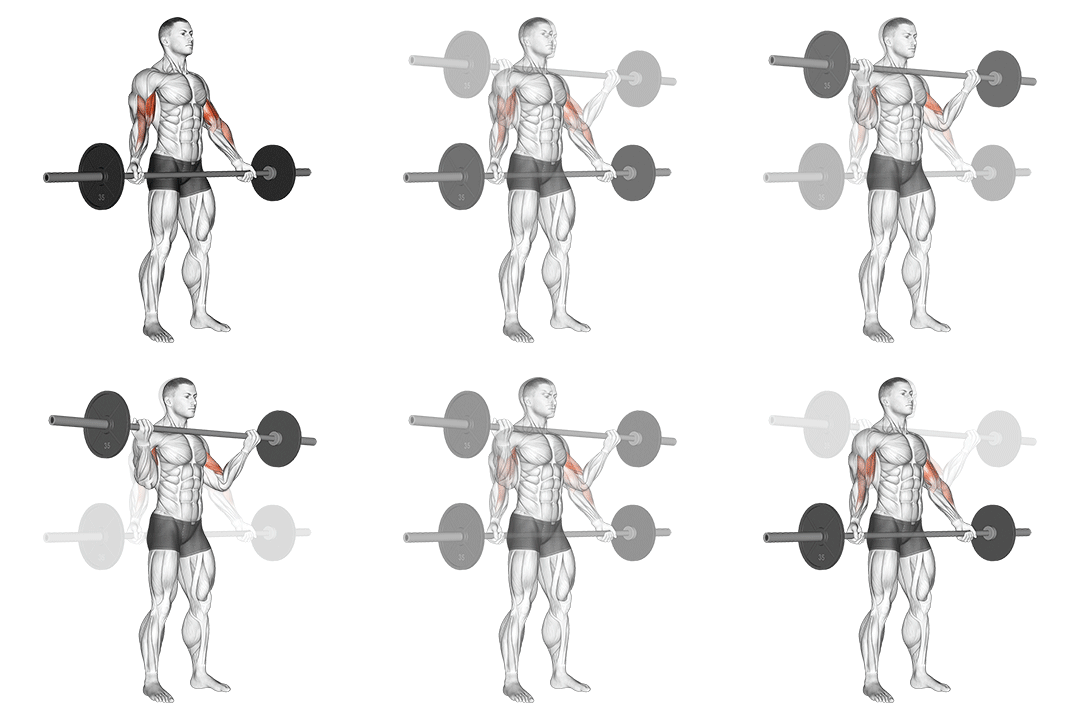
The Barbell Standing Wide Grip Biceps Curl performs curls with a wide (outside shoulder-width) grip. The wide grip emphasizes the short head (inner head) of the biceps.
For barbell bicep training, the wide grip curl produces short-head bicep emphasis. The wide grip changes the angle. Run it for 3 sets of 8 to 12 reps as short-head bicep work.
Stand with feet hip-width holding a barbell at the front of the thighs with underhand grip wider than shoulder-width (wide grip). Keep elbows pinned at the sides. Curl the barbell up by bending the elbows. The wide grip emphasizes the short head (inner head) of the biceps differently than narrower grips. Squeeze hard at peak contraction. Lower under control. The pattern produces short-head bicep loading that complements close-grip and standard curls for broader bicep development. Use as variation work alongside standard barbell curls.
How To Program These Workouts
A productive barbell bicep session pulls 4 to 6 exercises from the list above based on training goals. A common balanced session: barbell curl (mass), barbell preacher curl (isolation), barbell spider curl (isolation variation), barbell drag curl (long-head emphasis), barbell standing reverse grip curl (combined arm/forearm). For mass focus: barbell curl, barbell preacher curl, barbell spider curl, barbell standing close grip curl. For broader arm development: barbell curl, barbell standing reverse grip curl, barbell standing wide grip biceps curl, barbell drag curl. Run compound curl work for 3 to 4 sets of 6 to 10 reps, isolation curl work for 3 sets of 8 to 12 reps, and variation grip work for 3 sets of 8 to 12 reps. Total session covers 12 to 18 working sets focused on bicep development.
Train barbell bicep work 1 to 2 times per week as part of broader pulling-day or arm-focused programming. The biceps recover reasonably quickly but accumulate fatigue from compound pulling work that activates them substantially. Most successful programs include barbell bicep work either: 1) on a dedicated arm day with barbells as primary tools, 2) at the end of a back day after compound pulling, or 3) as part of complete barbell-emphasis training programs. Barbell bicep work is particularly valuable for heavy mass loading that develops elite bicep size given the bilateral loading capacity.
For broader bicep programming, see our how to grow your biceps and best bicep workouts. For specific barbell work, see our best barbell workouts.
Final Thoughts
The best barbell bicep workouts deliver real bicep development through patterns that effectively load the biceps with the unique advantages barbells offer: heavy bilateral loading capacity, varied grip widths for dedicated head emphasis, dedicated isolation patterns for strict bicep work, and reverse grip variations for combined arm/forearm development. The combination of standard curls, preacher curls, spider curls, drag curls, varied grip width curls, reverse curls, and lying preacher curls covers every functional pattern of the biceps and produces broader development than dumbbell-only training would suggest. The barbell curl in particular produces some of the most effective compound bicep mass loading possible due to the heavy bilateral loading capacity. For lifters who want elite bicep mass through heavy compound loading, want to build broader arm development through brachialis training via reverse curls, want strict isolation through preacher and spider curl variations, or want to break through bicep plateaus through varied grip widths, dedicated barbell bicep training is one of the most effective options available.
Stay focused on elbow position and full range. The most common barbell bicep training mistakes include letting the elbows drift forward during curls (which shifts work away from the biceps and reduces effective range) and using too-heavy barbells that force significant body english. The fix: keep elbows pinned at the sides throughout standing curl variations and pinned to the preacher pad on preacher curls, and use barbells light enough that 6 to 12 reps becomes challenging with strict form (no leg drive, minimal trunk swing). Quality reps with proper elbow position and full range produce stronger bicep development than ego-driven volume.
Frequently Asked Questions
Are barbell curls the best bicep exercise?
Among the most effective compound bicep exercises that exists. Barbell curls produce strong compound bicep mass through pure elbow flexion with the heavy bilateral loading the barbell allows. The pattern hits biceps through their primary function with maximum loading capacity. Many successful bicep programs build elite bicep mass primarily through heavy barbell curl training. Most successful programs include barbell curls as primary mass work, typically 6 to 10 reps with progressive heavy loading. The pattern is foundational for serious bicep development.
Preacher curl vs. spider curl?
Both effective; choose based on focus. Barbell preacher curls produce strict bicep isolation through the angled-pad position with bicep stretch in the bottom position. Barbell spider curls produce strict bicep isolation through face-down position with arms hanging straight down (different angle than preacher). Most successful programs include both: preacher as primary stretched-position isolation and spider as variation isolation work. The combination produces broader development than either alone, particularly for advanced lifters seeking maximum bicep isolation work.
Are reverse curls better than hammer curls?
Different – both effective. Barbell reverse curls produce strong brachialis and brachioradialis loading through pronated grip with the heavy bilateral loading the barbell allows. Dumbbell hammer curls produce brachialis loading through neutral grip with natural unilateral options. Most successful arm programs include both: reverse curls as primary heavy brachialis work and hammer curls as variation neutral grip work. The combination produces broader brachialis development than either alone, and both add substantial arm thickness.
How heavy should barbells be for biceps?
Moderate to heavy. Standard barbell curls use moderate to heavy weights (men: 65 to 135+ lb; women: 30 to 65+ lb). Reverse curls use slightly lighter weights (men: 55 to 115 lb; women: 25 to 55 lb) due to weaker pronated grip strength. Preacher and spider curls use moderate weights (men: 45 to 95 lb; women: 25 to 45 lb) due to the strict isolation. Most successful programs progressively load all exercises until 6 to 12 reps becomes challenging with strict form and minimal body english.
How often should I train biceps with barbells?
One to two barbell bicep sessions per week works for most lifters. The biceps recover reasonably quickly but accumulate fatigue from compound pulling work that activates them substantially. Most successful programs include barbell bicep work either on a dedicated arm day, at the end of a back day, or as part of complete barbell-emphasis training. Three or more weekly heavy bicep sessions typically produces overuse issues, particularly given the high bicep involvement in compound pulling.