Barbell Power Jerk

Description
The barbell power jerk is an overhead lift where you drive a barbell from the front-rack position to a locked-out overhead catch in a partial squat. Unlike the split jerk (which uses a split-leg catch), the power jerk catches the bar with both feet jumping out to a slightly wider squat stance. It allows heavier loading than the strict press while building explosive overhead power.
Muscle Group
Equipment Required
Barbell Power Jerk Instructions
- Set the barbell at upper-chest height in a power rack. Step under the bar and rack it across your front shoulders with elbows up.
- Unrack the bar and step back. Set your feet hip-width apart with toes pointed forward.
- Brace your core hard and lift your chest tall. Keep your elbows up.
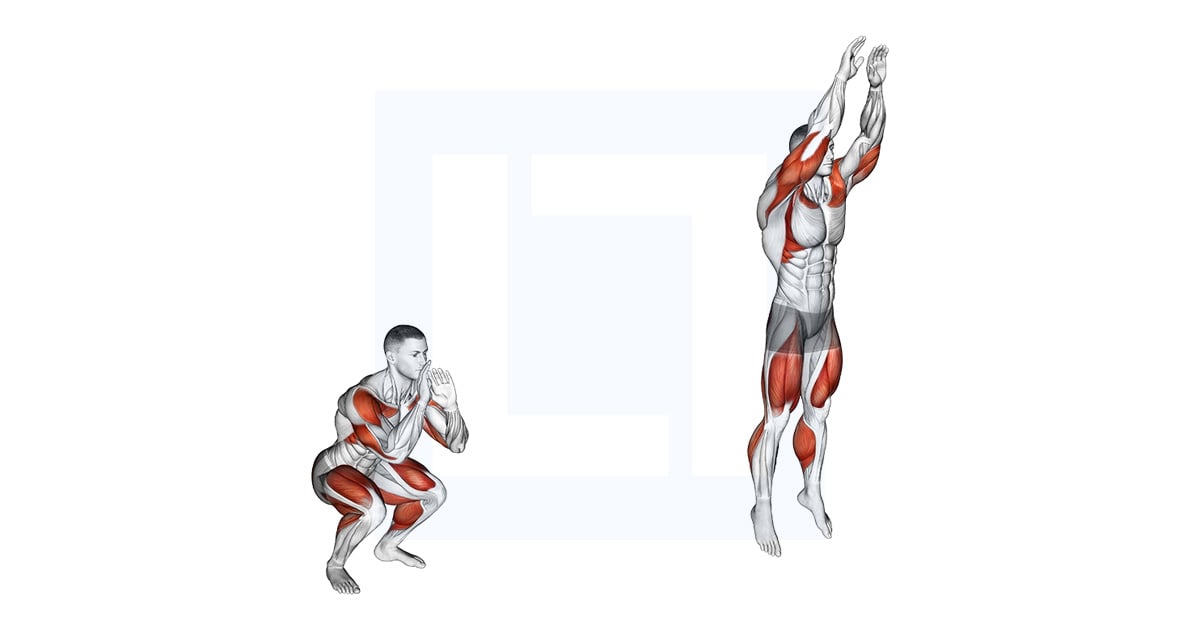
- Initiate the dip by bending only at the knees — about 10 to 15 cm. Keep your torso completely vertical.
- Reverse the dip explosively by driving through your feet and extending your hips and knees.
- As your legs reach full extension, immediately drop under the bar by jumping your feet out to a slightly wider stance and dropping into a partial squat.
- Catch the bar locked out overhead with arms fully extended. Your body should be in a partial squat with the bar directly above your shoulders.
- Stand fully tall to complete the rep. Lower the bar back to the front-rack and reset.
Barbell Power Jerk Form & Visual

Barbell Power Jerk Benefits
- Allows heavier overhead loading than strict pressing
- Builds explosive lower-body and overhead power
- Trains full-body coordination and timing
- Easier to learn than the split jerk for many lifters
- Carries over to athletic performance
- Foundational Olympic lifting accessory
Barbell Power Jerk Muscles Worked
- Anterior and lateral deltoid
- Triceps brachii
- Quadriceps (drive)
- Gluteus maximus (drive)
- Upper trapezius
- Core (stabilizer)
- Calves
Barbell Power Jerk Variations & Alternatives
- Barbell Split Jerk
- Squat Jerk (full squat catch)
- Dumbbell Push Jerk
- Kettlebell Double Jerk
- Kettlebell One-Arm Jerk
- Push Press (no catch)
- Behind-the-Neck Power Jerk
- Pause Power Jerk (1-sec hold at lockout)