Barbell Low Bar Squat

Description
The barbell low bar squat is the powerlifting style of squatting where the barbell rests low on the rear deltoids, across the spine of the scapula. The low bar position shifts emphasis to the hips and posterior chain (glutes, hamstrings) and uses a more forward-leaning torso. It allows lifters to handle heavier loads than high bar.
Muscle Group
Equipment Required
Barbell Low Bar Squat Instructions
- Set a barbell at chest height in a power rack.
- Step under the bar and place it across your rear delts, on top of the spine of your shoulder blades. Pull your shoulder blades together to create a “shelf.”
- Grip the bar narrow with elbows pointing back and down.
- Unrack and step back into squat stance — typically slightly wider than shoulder-width with toes turned out 30 degrees.
- Brace your core hard. Allow a moderate forward torso lean.
- Sit your hips back and break at the knees. Descend with hips moving back as much as down.
- Descend until your hip crease drops just below your knees (parallel for powerlifting).
- Drive your hips forward and up to stand. Squeeze glutes at the top.
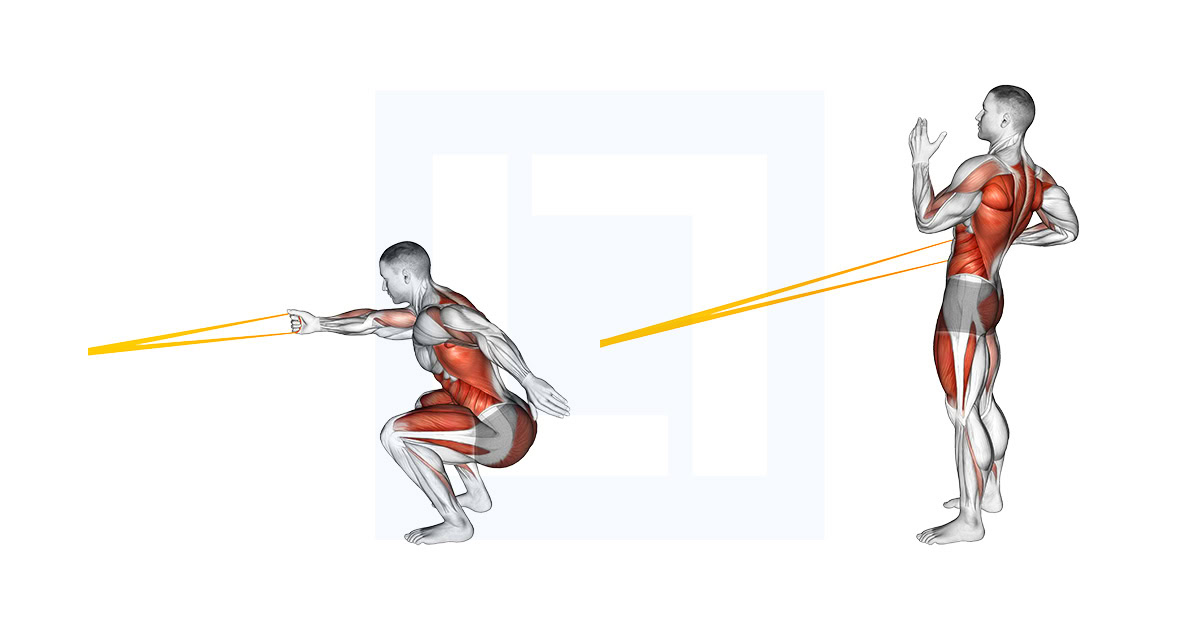
Barbell Low Bar Squat Form & Visual

Barbell Low Bar Squat Benefits
- Allows the heaviest squat loads
- Heavy hip and posterior chain emphasis
- Standard squat in powerlifting
- Builds the glutes and hamstrings
- Less mobility-demanding than high bar for some lifters
- Develops the squat-pattern hip drive
Barbell Low Bar Squat Muscles Worked
- Gluteus maximus (heavy emphasis)
- Hamstrings
- Quadriceps
- Adductors
- Erector spinae
- Core (heavy stabilizer)
Barbell Low Bar Squat Variations & Alternatives
- Barbell High Bar Squat
- Barbell Front Squat
- Bodyweight Squat
- Pause Low Bar Squat
- Box Squat (powerlifting)
- Tempo Low Bar Squat
- Trap Bar Squat