Balance Board

Description
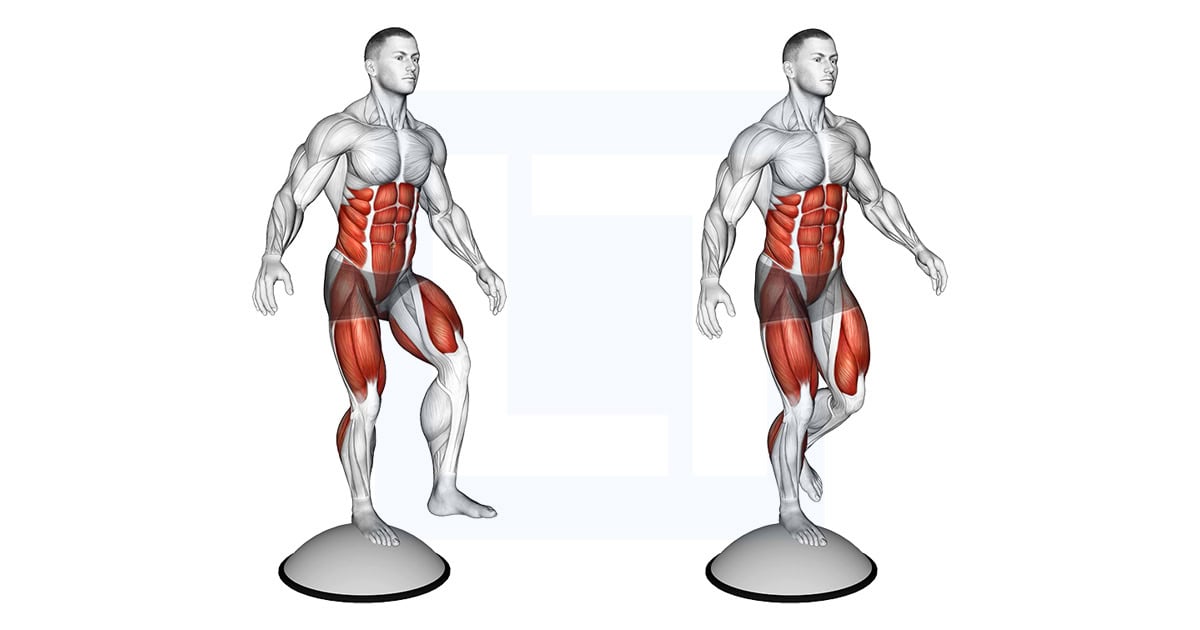
The balance board is a stability training tool where you stand on an unstable tilting platform (rocker board, wobble board, or Bosu ball) and maintain balance. It develops proprioception, ankle stability, and neuromuscular control. It is widely used in rehabilitation and athletic training.
Equipment Required
Balance Board Instructions
- Place a balance board, rocker board, or Bosu ball (flat side up) on a non-slip surface.
- Carefully step onto the board with both feet. Position feet hip-width apart.
- Find your balance. Engage your core and ankle stabilizers.
- Try to keep the board level — do not let the edges touch the floor.
- Hold the balanced position for 30 to 60 seconds.
- For progression: close your eyes, stand on one leg, add small squats, or catch and throw a ball.
- Use a wall or chair nearby for safety when first learning.
- Practice 3 to 5 sets per session.
Balance Board Form & Visual

Balance Board Benefits
- Develops proprioception and body awareness
- Builds ankle stability and control
- Useful for rehabilitation after ankle injuries
- Improves neuromuscular control
- Engages deep stabilizer muscles
- Widely used in physical therapy and sport training
Balance Board Muscles Worked
- Ankle stabilizers (tibialis anterior, peroneals)
- Calves
- Core (stabilizer)
- Gluteus medius (hip stabilizer)
- Foot intrinsic muscles
Balance Board Variations & Alternatives
- Squat on Bosu Ball
- Single-Leg Balance Board Hold
- Balance Board with Eyes Closed
- Balance Board Squat
- Wobble Board