Four Limbed Staff

Description
Four-Limbed Staff Pose (Chaturanga Dandasana) is the yoga equivalent of the bottom of a tight, narrow push-up. With elbows bent at 90 degrees and tucked close to the ribs, the body forms a straight line from heels to head. It builds tremendous upper-body and core strength and appears repeatedly in vinyasa flow.
Equipment Required
Four Limbed Staff Instructions
- Start in a high plank position. Hands directly under shoulders, body in a straight line.
- Shift your weight slightly forward so your shoulders move past your wrists.
- Lower your body by bending at the elbows. Keep elbows tucked tight against your ribs.
- Lower until your upper arms are parallel to the floor (elbows at 90 degrees).
- Maintain a perfectly straight body line from heels to head. No sagging hips, no piked butt.
- Hold for 1 to 5 breaths.
- To exit, push back up to plank or roll forward into upward-facing dog.
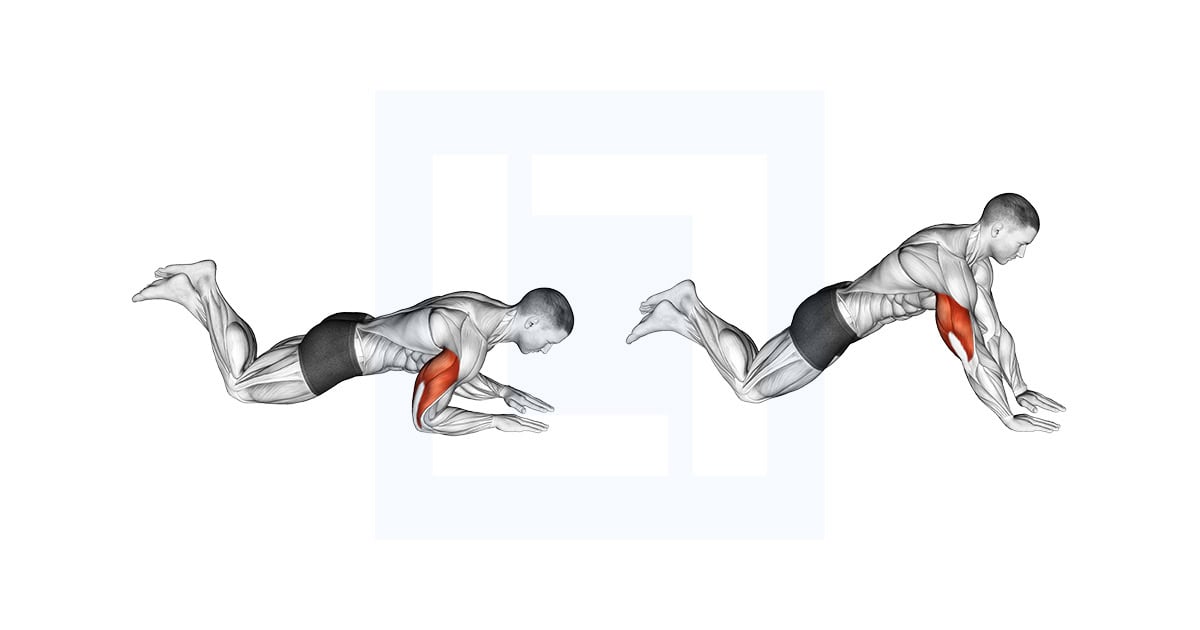
- If too difficult, drop to your knees first (knees-down chaturanga).
Four Limbed Staff Form & Visual

Four Limbed Staff Benefits
- Builds tremendous upper-body and core strength
- Foundational vinyasa yoga pose
- Develops stability and body control
- Strengthens the chest, shoulders, and triceps
- No equipment needed
- Builds endurance for longer yoga practices
Four Limbed Staff Muscles Worked
- Pectoralis major
- Triceps brachii (heavy emphasis)
- Anterior deltoid
- Serratus anterior
- Core (entire trunk)
- Erector spinae (isometric)
Four Limbed Staff Variations & Alternatives
- Knees-Down Chaturanga (regression)
- Plank Pose (high plank — easier)
- Vinyasa Flow
- Chaturanga Pose
- Diamond Push-Up (similar tucked-elbow position)
- Tempo Chaturanga (slow descent)